
Tea News Update
October 2026

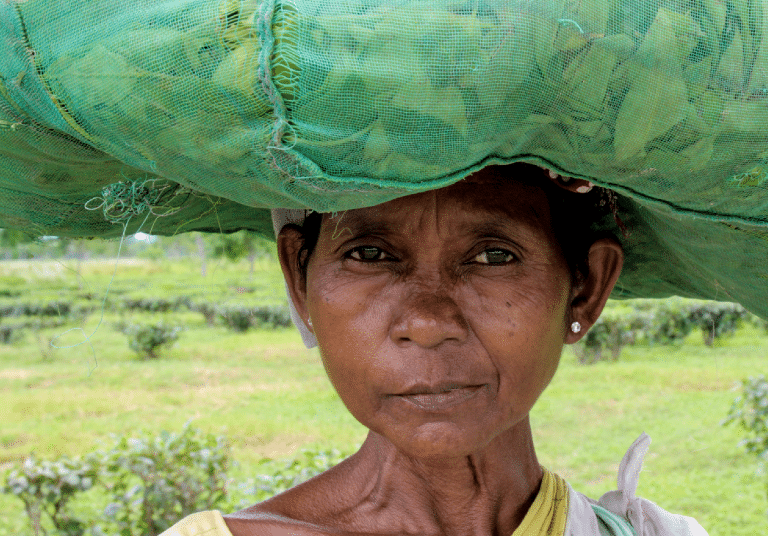
Gita Rani Kanu – tea worker leader who has been arrested after allegedly being assaulted. Photo: Bangladesh Feminist Archives
Tea news summary
Tea workers across producing countries face mixed benefits from the trade unions that are supposed to protect their rights. In Assam, trade unions secured 20% Durga Puja bonuses and campaigned for higher wages, yet Adivasi youth organisations appear most active on workers’ broader rights. More troubling, Bangladeshi tea worker leader Gita Rani Kanu was allegedly attacked by Bangladesh Tea Workers’ Union officials during a rally demanding Tk 500 (about US$4) a day, then jailed on the union’s complaint. Front Line Defenders is demanding an independent investigation. THIRST is developing research into how effectively tea unions protect workers’ human rights.
Inadequate wages intensify pressure on tea workers and farmers as living costs everywhere rise. Bangladeshi workers are still demanding Tk 500 a day, Nyayo Tea Zones staff in Kenya allege 11 months without pay, and workers at closed West Bengal estates lack both wages and state assistance. Tea prices, unchanged for 20 years, underpin low pay. Lidl’s “Way To Go! Tea” pays Kenyan growers extra in a bid to close the living income gap, but its £1.99 (US$2.66) shelf price has drawn criticism.
Workers also face poor physical and mental health, wild animal attacks, and worsening climate impacts, from drought in the Nilgiris to record-low Sri Lankan output. Land disputes have led to violence. Positive developments include government welfare funding, ISO 45010’s menstruation and menopause guidance, Tinsukia’s ban on carrying workers in goods vehicles, and new yield-boosting technologies.
Are tea trade unions failing their members?
Tea trade unions are active across South Asia, negotiating collective bargaining agreements, calling for better pay (including bonuses), calling workers out on strike when agreements fall through, etc.
In Assam, India, more than 5,000 people joined a rally organised by the Centre of Indian Trade Unions (CITU) against the new Labour Codes, calling for a Rs 661 daily wage for tea workers (Assam Tribune, 29.09.26). Separately, the Assam Chah Mazdoor Sangha (Assam Tea Workers’ Union), affiliated to INTUC, successfully called for the maximum 20% bonus to be paid across Assam at least three weeks before the Durga puja festival (Northeast Now, 21.09.26). By mid-September, all 73 large estates that had announced bonuses had set them at 20%, though some are paying in two instalments (The Times of India, 17.09.26). The state government matched this for its own ATCL plantations (The Print, 24.09.26).
However, it is the Adivasi youth organisations that seem to be most active in campaigning for tea workers’ broader rights in Assam. For example the demanding minimum wages, provident fund benefits, bonuses and safe transport (India Today, 02.09.26), and urging the Chief Minister to act on alleged exploitation and denial of statutory rights (The Assam Tribune, 03.09.26). Reports of workers who stopped work at Behora tea estate to demand a 20% bonus ahead of Durga Puja and an on-site ATM do not mention trade union involvement (The Sentinel, 20.09.26). Still in Assam, the Assam Chah Karmachari Sangha (ACKS) (staff union) is pushing for the sale of five McLeod Russel estates held up until workers’ unpaid gratuity, PF and pensions are settled (The Sentinel, 17.09.26).
As THIRST’s 2022 study found, some tea plantation workers are not being as well represented by their trade unions as they should be. Problems include lack of female representation, political influence and weak CBAs.
But an even more troubling story has emerged this month of a trade union physically attacking workers.
Tea worker, Gita Rani Kanu, had been leading workers in daily two-hour work stoppages across Sylhet Valley plantations since 26 August, demanding a Tk 500 (approximately USD 4) daily wage, immediate Tea Workers’ Union elections, cancellation of a 2023 gazette notice, and land rights (Daily New Nation, 28.08.26).
On 31 August, Kanu led a rally in Sreemangal. Protesters say they were attacked as they passed the Bangladesh Tea Workers’ Union office, injuring 10 to 12 people. Kanu was among three people taken to hospital (Red Times, 01.09.26). The union’s general secretary then filed a complaint accusing her of assault, theft and vandalism. Police arrested her on 2 September, and a court sent her to jail. Protesters claim that video footage of the alleged attack is available and allege that police stood by and did not intervene during the assault. They say the case was lodged while they were receiving treatment, before they could file their own (Dhaka Tribune, 04.09.26).
Calls for Gita Rani Kanu’s release have grown (The Daily Star, 10.09.26). Front Line Defenders is demanding that the charges be dropped and that the attack be independently investigated (Front Line Defenders, 11.09.26).
Meanwhile, a government taskforce set up to look into persistent issues in the Bangladesh tea industry has been criticised for not including a single worker representative. (Daily Star 07.10.2026)
This is not the first allegation of trade union representatives assaulting workers. In 2015 when the women of Munnar’s tea plantations mounted a protest; Gomathi Augustine, one of the leaders of the Pempila Orumai strike, and her family were allegedly physically attacked by trade union representatives after winning a local election (The News Minute, 9.11.2015)
THIRST is developing a project to research tea trade unions across key tea origins, exploring the extent to which they are succeeding in securing tea workers’ human rights and what needs to be done to improve the situation. Contact us if you would like to support this work or be involved in anyway as a trade union, academic, plantation manager or owner or tea brand.
Wages are the most pressing issue for most tea plantation workers
Across the globe people are struggling to cope in the face of rising living costs caused by the wars in Ukraine and West Asia. For tea plantation workers the struggle is intensified by stagnant wages or minimal wage rises.
In Bangladesh, workers say rising living costs make their wages inadequate and are still demanding Tk 500 (about US$4) a day (New Age, 13.09.26). After distributing raincoats to women workers, a government minister said wages must allow a dignified life, but did not commit to a figure. He pointed instead to plans to make plantations profitable, including solar power and timber (The Financial Express, 22.09.26).
Kenya offers a more mixed picture – more than 8,000 Eastern Produce Kenya workers will get a 14% pay rise over two years (The Star, 31.08.26). By contrast, staff at the state-owned Nyayo Tea Zones allege they have gone 11 months without pay. One worker earning KSh 8,110 (about US$63) a month would be owed around KSh 89,210 (about US$688) (Nyakundi Report, 19.09.26).
Workers at closed tea plantations in West Bengal, India, are also struggling without wages. Panighatta Tea Estate has been shut since 29 August, the latest in a decade of closures. Workers want to negotiate directly with the owner rather than through politicians, and say families can no longer afford school costs (Sikkim Express, 11.09.26). In Alipurduar, about 4,400 workers at three closed estates have gone months without the state’s ₹1,500 (about US$16) monthly assistance. Application forms were only distributed on 24 September, and unions want payments backdated (The Telegraph Online, 24.09.26).
In response to the problem, India’s central government approved a Rs 330 crore (about US$34 million) scheme to support workers in closed plantations and help reopen them (The Statesman, 22.09.26). The labour minister gave the 21 officially closed plantations seven days to submit reopening plans and insisted workers’ unpaid dues be settled (The Print, 25.09.26).
The ILO is working with government, employers and unions in Sri Lanka to strengthen wage-setting in sectors including tea (ILO, 09.09.26).
NB THIRST, Fairtrade and Teekampagne are organising a Darjeeling Tea Multistakeholder Roundtable (see THIRST News) using wages as a starting point to discuss how to collaborate to tackle the sector’s issues. Attendance is by invitation. Please contact us if you would like to attend.
Better prices could boost wages
As pointed out at the recent ETP forum (under the Chatham House Rule), “The price of tea has not changed in 20 years.” Meanwhile, the costs of production are steadily rising.
In Kenya, a smallholder tea farmer says green leaf now fetches Sh26 (about US$0.20) a kilo, enough to pay his workers and keep a little for himself. However, his factory is still repaying a Sh1.2 billion (about US$9.3 million) loan, so a declared year-end bonus of Sh20 (about US$0.15) a kilo shrinks to Sh12 (about US$0.09) by the time it reaches farmers. Another farmer said she cannot afford her children’s school fees and wants factory directors to raise pay to at least Sh50 (about US$0.39) a kilo (The Star, 22.09.26).
One UK supermarket, Lidl GB has responded to the problem by launching “Way To Go! Tea” designed to help close the living income gap for Kenyan tea growers. On top of the Fairtrade Minimum Price and Fairtrade Premium, Lidl is paying an extra amount per kilo, based on a Living Income Reference Price worked out with Fairtrade. The Fairtrade Foundation welcomed the move, noting that only one in five Kenyan tea farmers earns enough each month to cover their family’s essentials (Grocery Trader, 15.09.26).
There has, however, been criticism from some industry stakeholders, of the shelf price of the tea – £1.99 (US$2.66) for 80 teabags which, although Lidl’s business model allows it to keep prices low, commentators feel gives the wrong signal to consumers about a feasible price for tea to meet the cost of its sustainable production.
Another way of improving the price of tea is to capture more of the value at source; the Tea Board of India deputy chairman, Murugan, urged small tea growers to stop selling only raw green leaf and to set up mini tea factories to process their own tea. He promised the Board would help them gain “Tea Mark” certification and reach buyers directly through its online platform, teamarketplace.in (The Covai Mail, 02.09.26).
Diversification of the teas on offer is yet another way to ensure better prices. The Tea Board and Kashmir region’s agriculture department held a workshop to promote Kashmiri Kehwa, a green tea flavoured with aromatic spices. The aim is to raise the profile of this little-known local product nationally and internationally, benefiting producers, traders and local entrepreneurs (Jammu Links News, 14.09.26).
Land rights struggles persist from colonial times to the present day
The documentary Kikuyu Land, which has been released in UK cinemas, traces how Kenya’s Kikuyu people lost their ancestral land under colonial rule to make way for plantations, and argues that multinational companies have continued the same pattern of exploitation (The Guardian, 28.09.26).
In India, tea workers are facing modern day challenges to their land rights; in Tripura workers say their livelihoods are under threat after land at Mekhlibon Tea Estate was allegedly seized by a group of up to 40 people who tried to occupy part of the estate and cut down around 350 tea plants and saplings. They also say they have been blocked from plucking leaves there and threatened with death if they enter the disputed area (Tripura Chronicle, 09.09.26). The dispute follows the state assembly’s passing of an amendment to Tripura’s land revenue law. Critics fear its provisions on tea plantation land could encourage attempts to divert it from tea cultivation. Workers allege the land is being taken in the name of building a playground and fear further encroachment could hit production and jobs (Tripura Info, 10.09.26).
In Assam, large estates complain that some small growers avoid paying minimum wages and welfare benefits (The Sentinel, 16.09.26). The state’s finance minister says small tea growers struggle to get loans because of land-title problems (The Assam Tribune, 20.09.26).
Government, investment and welfare funding support for tea workers
Tea workers and smallholders in several countries are getting new support, from investment and welfare funding to basic equipment.
In Rwanda, The Wood Foundation Africa has taken a co-majority stake in Mushubi Tea Factory with Rwanda Mountain Tea. The factory works with 1,973 smallholders and plans to bring in a further 2,500 (The New Times, 10.09.26). Uganda‘s government is distributing free fertiliser to revive a struggling sector. In Mityana District, 230 tea outgrowers will share 1,000 bags (New Vision, 19.09.26).
In India, the central government has sanctioned ₹313.30 crore (USD 32.4 million) for the welfare of tea workers and their families in north Bengal (The Telegraph Online, 19.09.26). But smallholder tea farmers face different challenges; Jalpaiguri’s small growers have urged the government to allow plucking until 31 December, warning that an earlier cut-off could put 25,000 growers in financial distress (Millennium Post, 08.09.26).
In Bangladesh, an MP handed out raincoats to 2,500 women tea workers in Kulaura, fulfilling an election promise (The Daily Observer, 14.09.26).
In Laos, the EU-funded SOLAR II project, led by the ILO, will spend €3.5 million by 2030 on social protection and labour rights. It aims to reach about 32,000 coffee, tea and forestry workers and small producers, at least half of them women (Lao News Agency, 29.09.26).
Research from China suggests such support pays off. A Ningxia University study found that tea farmers who used agricultural support services earned 17 to 19% more and reported higher well-being (EurekAlert, 21.09.26).
The Burundi Tea Board is considering paying more for green leaf and increasing fertiliser supplies after tea production has fallen by 30% in ten years, and more than 1,300 hectares of plantations have been abandoned or destroyed. (SOS Medias Burundi, 07.09.26).
Bangladesh‘s Commerce Minister has promised a long-term strategy to make the tea industry commercially viable. He warned that even one plantation closing could seriously harm workers and their communities (Daily Asian Age, 22.09.26).
Uganda plans to write off more than Shs35 billion (about US$8.7 million) in tax arrears owed by tea factories hit by falling auction prices (Kenyan Wall Street, 12.09.26). Kenya has set aside Sh10 billion (about US$77 million) to modernise smallholder tea factories and subsidise fertiliser (Kilimo News, 11.09.26). President Ruto has also launched a Sh3.1 billion (about US$24 million) tea access road in Kericho (Kenya News Agency, 14.09.26).
Climate crisis impacts intensify across tea origins
Tea-growing regions across Asia and Africa are under severe climate pressure. In India, a 55% shortfall in the southwest monsoon, attributed to Super El Niño, has cut Nilgiris green leaf yields from about 500 kg to 200 kg per acre a month. Growers describe it as the worst decline in decades. Procurement prices remain below Rs 20/kg, and many of the district’s 65,000 small farmers cannot afford irrigation. They are calling on the Tamil Nadu government for financial help (Telangana Today, 31.08.26; Big News Network, 05.09.26). In Assam, extreme heat and erratic monsoons are harming workers’ health. Women, around half of the workforce, are reporting skin infections and diarrhoea (Hub News, 09.09.26).
Sri Lanka faced the opposite problem. Heavy rain pushed August’s high-grown output to a 34-year low of 3.1 million kg, and forecasters warn of hot, dry conditions in early 2027 (Adaderana, 17.09.26).
Kenya supplies about half of Britain‘s black tea. There, hailstorms, heavy rain and drought cut production in some Kericho cooperatives by 30% in May and June. Farmers report falling incomes, loans and hunger, and say middlemen take most of the gains from higher global prices (Eastern Eye, 21.09.26; The Cooldown, 25.09.26). The government is speeding up research into climate-resilient varieties (Eastleigh Voice, 18.09.26).
Tea workers suffer poor physical, psychological health, and violence
Two studies published last month demonstrate poor health indicators for tea workers, while violence and inadequate healthcare provision continue to claim tea workers’ lives.
In Bangladesh, a study of 451 working mothers in Moulvibazar’s tea plantations found that a third had poor psychological well-being and another 41% were vulnerable. More than 60% reported depression, anxiety or chronic stress. Workers can earn BDT 178 (about US$1.40) for picking 24 kg of leaves, and many take on high-interest microloans to get by (Asia News Network, 08.09.26). City Bank and Oxfam have partnered to improve water, sanitation and hygiene in tea plantation communities, with a focus on women and girls (New Age, 24.09.26).
In India, studies point to neglected health problems. In the Nilgiris, nearly two-thirds of plantation workers examined had advanced gum disease, and only 11% used a toothbrush with toothpaste (DT Next, 31.08.26). In Darjeeling, noise-induced hearing loss was common in tea factories, and no workers were seen using hearing protection (Cureus, 16.09.26). In Assam, a commentary argues that debates on pesticide residues in tea overlook the workers who mix and spray the chemicals (East Mojo, 15.09.26).
Tinsukia district saw several incidents. A worker at Rupai Tea Estate died after collapsing on duty, allegedly because no ambulance was available (Northeast Now, 12.09.26.
A farmer was sustained a serious head injury when he was attacked while trying to stop thieves stealing tea leaves (Northeast Now, 28.09.26). The incident has echoes of a similar clash in Kenya earlier this year in which several people were injured during a land dispute – and worker was shot with an arrow as he tried to flee (People Daily 03.07.26). These incidents demonstrate the volatility of life in certain segments of the tea sector where disputes are allowed to fester unresolved by officials.
There were, however, two pieces of positive news for tea worker health and safety. Tinsukia’s district administration has banned tea plantation owners, factory managements and construction contractors from carrying workers in goods and cargo vehicles. It says the practice is unsafe and breaches the conditions under which goods vehicles are allowed to operate under the Motor Vehicles Act, 1988. Employers must now provide proper passenger vehicles, such as buses, minibuses or vans, with adequate seating, and those who break the order face strict legal action (India Today, 23.09.26).
Also last month, the International Organization for Standardization published ISO 45010, the first international standard guiding organisations on supporting employees through menstruation and menopause at work. Part of the ISO 45000 occupational health and safety family, it covers workplace culture, policies, manager training, workplace design and practical adjustments. One commentator says the standard is especially relevant to Sri Lanka, where women make up 65 percent of the tea-plucking workforce, and many tea and apparel workers are perimenopausal or menopausal. Heat, prolonged standing, inflexible shifts, poor sanitation and little rest compound their symptoms, a burden that neither workers nor employers are equipped to recognise or address. (Daily News, 14.09.26). The same is true of virtually all tea producing regions.
Tally of attacks by wild animals on tea workers continues to rise
In Sri Lanka’s hill country, two wasp attacks in three weeks have left one worker dead and 24 injured. Seventeen plantation workers, 16 of them women, were taken to hospital after being stung while plucking tea in Hatton (Adaderana, 31.08.26). At the Lindula Waltrim Estate, a 77-year-old father of three died and seven other workers were injured. The nest is believed to have been disturbed by bad weather. (The Morning, 22.09.26).
In Kerala, India, a worker narrowly escaped when one of two wild elephants that had wandered into the plantation at dawn charged at him outside his line house. He outran the animal and sheltered in a nearby bungalow. Residents say elephant incursions are a recurring problem and are calling for a permanent solution, tighter surveillance and more forest department patrols to keep the animals away from workers’ homes (The Times of India, 04.09.26).
New technology is changing how tea is grown
New technology is changing how tea is grown, from smallholders’ fields to national monitoring systems.
In India, the Tea Board has set up five weather stations in two Nilgiris villages. They give small growers local information on weather, yields, quality, and pest and disease control (Deccan Chronicle, 02.09.26). The Board has also signed an agreement with the space agency ISRO’s remote sensing centre and NIT Rourkela to build an AI system. It will use satellite data to monitor plantations nationwide, spotting crop stress and pests and estimating yields (The Economic Times, 04.09.26).
In Sri Lanka, plucking machines distributed by the non-profit Berendina Development Services have almost doubled daily yields. An assessment of 97 workers found output rose from about 24 kg to 44 kg per worker, and monthly household income went up by an average of Rs 12,500, about US$38 (Daily News, 03.09.26).
In Rwanda, Chinese experts trained tea sector staff in Kigali on testing for pesticide residues and food safety (English News, 19.09.26). In China, researchers at Fujian Agriculture and Forestry University have built a model that detects tea leaf diseases in real time in the field. It would let farmers spray only infected plants rather than whole fields (Bioengineer, 22.09.26).
Share this update
Sign up for our monthly newsletter to stay in the know about human rights in the tea sector
Each issue of our newsletter includes:

A summary of the latest tea sector news

Upcoming THIRST events

THIRST news and updates

New reports and resources from our Knowledge Hub
Latest news, views and events
View all Upcoming Event

 THIRST news
THIRST news November 2026
Catch up on THIRST’s latest news, including our final webinar of the year, a new guest blog, new Knowledge Hub resources and…
 Tea News Update

Tea news November 2026
Bonus unrest season returns; small but transformative climate adaptations adopted; GBVH persists alongside studies; real and continued danger to tea workers’ lives.