
What can the tea sector learn about sustainability from tomatoes?

Upcoming event
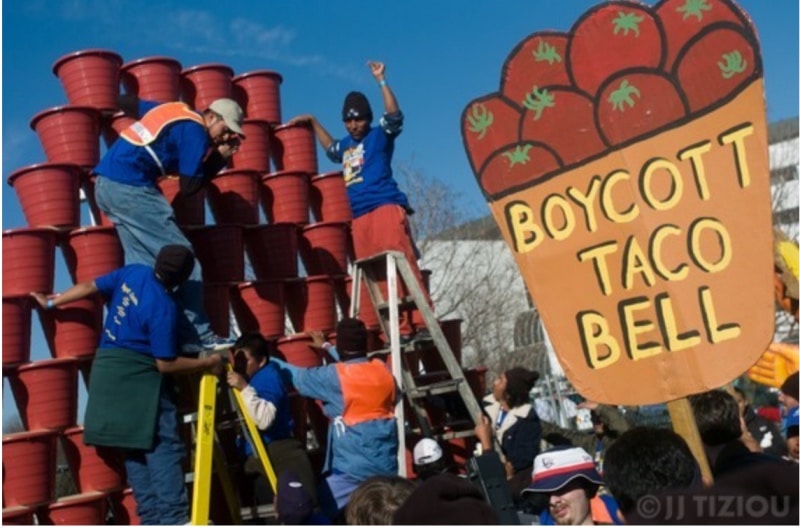
Tomato workers from Immokalee protest low wages outside Yum Brands’ headquarters in Kentucky in 2003 Coalition of Immokalee Workers © JJ TIZIOU
What can the tea industry learn from migrant farm workers who organised to demand better pay and working conditions?
In Florida’s tomato fields, migrant workers faced decades of low wages, harassment, exploitation and unsafe working conditions. Migrant workers from countries, including Mexico, Haiti and Guatemala came together to demand change.
Through the Coalition of Immokalee Workers, they organised protests, hunger strikes and a nationwide boycott of Taco Bell, calling on major food companies to take responsibility for the conditions faced by workers in their supply chains.
Their efforts helped bring about the Fair Food Program, a pioneering model of worker-driven social responsibility that puts workers at the centre of setting and enforcing labour standards.
The programme has helped improve pay, tackle harassment and abuse and establish systems that protect workers who report problems from retaliation. It has also shown how legally binding agreements between workers, growers and major buyers can bring about lasting improvements.
What could a similar approach mean for tea workers and farmers?
Join us for the final webinar in THIRST’s What can tea learn from other sectors? series as Dr Alysha Shivji (Research Professor at EGADE Business School, Tecnológico de Monterrey) examines how Florida’s tomato workers challenged powerful companies, why worker-led standards matter, the power of enforcement and what their experience could teach the tea industry about accountability and responsible purchasing.
The discussion will also look at other approaches to responsible sourcing and collaboration with time for participants to ask questions and share their perspectives.
Register now to join the discussion.
Date and time

Ticket price
FREE. Donations welcome.
Why is this subject important?
Low wages, harassment, unsafe working conditions and limited worker representation remain serious challenges across the global tea industry.
Despite years of audits, certification schemes and corporate commitments, many tea workers still struggle to have their concerns heard or their rights protected.
Florida’s tomato industry faced similar problems. The Fair Food Program offers a different approach, one in which workers themselves decide what needs to change and have a direct role in making sure those changes happen.
It also challenges the idea that improving working conditions is solely the responsibility of producers. By securing legally binding agreements with major food companies, workers showed how buyers can be held accountable for conditions further down their supply chains.
For the tea industry, this raises important questions about how workers can have a stronger voice, how companies can take greater responsibility and what it takes to achieve meaningful improvements.
What will this webinar cover?
Drawing on research into Florida’s tomato industry, the webinar will explore how migrant farm workers organised to challenge exploitation and develop a system that has improved working conditions.
The webinar will examine:
- How the Coalition of Immokalee Workers used collective action, including a nationwide boycott of Taco Bell, to secure better pay and commitments from major food companies.
- How the Fair Food Program works, including worker-led standards, legally binding agreements and independent monitoring.
- Why workers are often best placed to identify unfair practices with examples from Florida’s tomato industry.
- How the programme has tackled harassment, abuse and retaliation, giving workers safer ways to raise concerns and seek redress.
- The challenges of changing long-established workplace practices and building trust between workers, growers and buyers.
- What other approaches, including collaboration between companies on responsible sourcing, can teach us about improving conditions in agricultural supply chains.
How will attending this event benefit me / my organisation?
This webinar offers an opportunity to learn from an approach that has delivered real improvements for agricultural workers and consider what those lessons could mean for tea.
Whether you work for a tea company, producer, trade union, NGO, certification body or another organisation involved in the sector, you will gain insights into:
- Strengthening worker voice: How involving workers in setting and enforcing labour standards can lead to more effective protection of their rights.
- Improving accountability: How legally binding agreements and responsible purchasing practices can encourage companies to take greater responsibility for working conditions.
- Making complaints systems work: Why protecting workers from retaliation is essential if they are to feel safe reporting harassment, abuse or unfair treatment.
- Moving beyond traditional approaches: What worker-driven social responsibility can offer alongside existing auditing, certification and corporate sustainability programmes.
- Applying lessons to tea: Practical ideas and questions to help your organisation consider how to strengthen worker participation and improve human rights in its own operations or supply chains.
There will also be time for questions and discussion about the opportunities and challenges of applying these lessons to tea.
About the speakers
Dr Alysha Shivji is a Research Professor at EGADE Business School, Tecnológico de Monterrey, Mexico, where she teaches business ethics, sustainability, corporate governance and AI ethics.
Her research focuses on worker-led approaches to improving labour conditions, business and human rights and social justice.
Alysha was also a Research Associate at THIRST and contributed to our human rights impact assessment of the tea sector. Her doctoral research at Alliance Manchester Business School examined how workers in the agricultural and food sectors can seek remedy when their rights are violated.
Alysha has worked with Apple and Stanford University on research relating to sustainable supply chains and efforts to tackle human trafficking. She holds a BA and MA in Sociology from Stanford University.
This webinar tackles the following root causes of human rights breaches in the tea industry
The low price of tea
Low prices paid for tea put pressure on producers’ ability to provide decent wages and working conditions. Florida’s tomato workers faced similar challenges with growers arguing that low prices paid by major buyers prevented them from increasing wages. Their successful campaign shows how holding buyers accountable can help improve workers’ earnings.
Power imbalances
Tea workers often have little say over their pay, working conditions or the decisions that affect their lives. The Fair Food Program shows how collective action and worker-led standards can help shift the balance of power, giving workers a stronger voice and greater influence over their working conditions.
Attitudes towards workers
Disrespectful and discriminatory attitudes can allow harassment, exploitation and abuse to continue. The Fair Food Program demonstrates how worker education, stronger protections and meaningful accountability can challenge these attitudes and help create safer and more respectful workplaces.
Over-reliance on certification
Audits and certification schemes do not always uncover human rights abuses, particularly when workers fear speaking out. Worker-led standards, independent monitoring and effective complaints systems offer another way to identify problems and ensure they are addressed.
Competition over collaboration
Many problems in agricultural supply chains are too widespread for individual companies to tackle alone. Agreements between workers, growers and major buyers show how collaboration can improve working conditions across an industry, rather than leaving responsibility to individual producers.
Laws and policies
Even where laws exist to protect workers, poor enforcement can leave them vulnerable to exploitation. The Fair Food Program shows how legally binding agreements, independent monitoring and protection against retaliation can help ensure workers’ rights are respected in practice.
Deeply ingrained resistance to change
Long-established working practices and attitudes can make improvements difficult. Florida’s tomato industry shows how sustained worker organising, education and accountability can challenge entrenched practices and bring about lasting improvements in working conditions.
Related resources
-
Assessment of the fundamental right to a safe and healthy working environment in Nepal’s tea sector
 Report ILONepal
This report examines working conditions in Nepal’s tea and cardamom sectors, highlighting poor workplace safety, limited access to public services and weak trade union representation. It explores the challenges faced by workers, particularly women, who are at greater risk of…
-
People with Disabilities in the Tea Sector Factsheet
This factsheet examines the challenges faced by people with disabilities in tea-growing communities, including barriers to employment, education and healthcare. It highlights the particular difficulties faced by women and girls with disabilities and the need for better data, stronger implementation…
-

What can the tea sector learn from garments?
Krishanti Dharmaraj, CEO of Dignity Index Global, and Dhivya Rakini, former president of Tamil Nadu Textile Commons Union, discuss the highly successful Dindigul Agreement, a landmark agreement to address GBVH in an Indian garment factory. The agreement offers valuable lessons…
-

The Dindigul Agreement to End Gender-based Violence and Harassment HAS IT WORKED?
Report ILR Global Labor Institute, Cornell UniversityIndia, India, Tamil NaduThis report examines the impact of the Dindigul Agreement, introduced in 2022 to tackle gender-based violence and harassment in garment factories in India. The report finds that workers are more confident about reporting abuse, complaints are resolved more quickly and…