
THIRST Tea News Update
February 2026
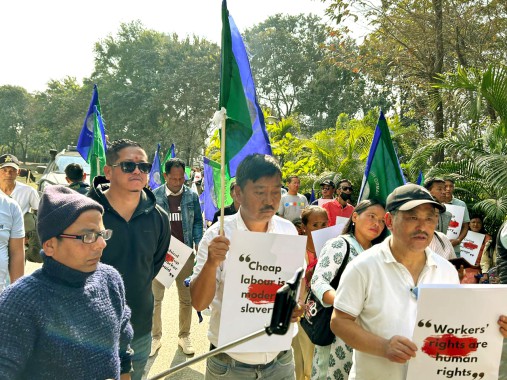
IGJF demands minimum wages for tea garden workers. Photo: Sikkim Express
The headlines
Tea producers across Asia and Africa are facing diverse climate and environmental challenges. In Nuwara Eliya, Sri Lanka, heavy rain and early morning frost are damaging tea leaves and reducing yields. In Kenya, prolonged sun exposure is affecting tea workers’ skin health, revealing under-recognised risks despite natural protection from darker skin tones. Elsewhere, innovation is emerging: China is combining solar power with tea farming to improve quality and incomes, while Vietnam’s farmers are adopting digitised, organic “green production” models to boost sustainability and transparency.
Protests over land-rights and wages persist across South Asia; in Sri Lanka, marginalised Tamil plantation workers protested in Colombo, demanding land rights, housing, and post-climate-disaster rehabilitation, as the government prepares a long-awaited wage rise aimed at easing economic hardship. Similar demands are echoed in India, where tea workers have rallied for minimum wages amid estate closures, unpaid wages, and calls for new management in struggling gardens. The roll-out of Assam’s land-allocation to tea workers has begun, welcomed by workers but raising concerns among plantation owners.
Kenya’s government has banned the use of tea farmers’ funds as collateral for bank loans to reduce financial risk and curb profiteering by factory managers, alongside broader changes at the Kenya Tea Development Agency. The government also aims to raise farmers’ green leaf earnings to Sh100 per kilogram by 2027 through measures to stabilise prices and improve quality. Separately, regulators have ordered stricter handling of auction proceeds to enforce compliance with tea sector laws.
Tea workers and their families across South Asia continue to face deadly risks from wildlife. In India, leopard attacks in tea-growing regions have increased year-round, killing and injuring children, while an elephant attack claimed the life of a tea worker near the Bhutan border. In Sri Lanka, several estate workers were injured in wasp attacks.
Climate extremes hit tea workers – solutions sought
“Farmers and estate managers in the Nuwara Eliya region [of South India] are facing severe challenges due to heavy rains combined with early morning frost. The frost has caused significant damage to tea plantations, with leaves drying up and reducing overall yields, according to estate managers.” (The Morning 21/01/2026)
The problems in Kenya are caused by the opposite of cold. “Sylvia Muteshi, tea plantation worker, Kenya says “My skin is darker than it used to be and I have also noticed dark patches forming on my cheeks, marks that do not fade. Some of the other women say it’s from the sun—that the light stains our skin after so many years in the field.”… Research shows that while darker skin offers protection against sun-related skin cancer, Black Africans still face serious risks that many people don’t know about.” (SciDev Net, 26/01/2026)
But further east, efforts are being made to harness the sun’s energy; “China’s state-owned CHN Energy has switched on the first 32 MW of an agrivoltaic project constructed among tea terraces…A statement on CHN Energy’s website says the integrated solar-plus-tea plantation model creates a positive micro-cycle system in which the solar panels provide moderate shade that helps improve tea quality, while maintenance of the tea plantation offers environmental protection for the solar array. The statement adds that the project is also increasing local residents income through land lease payments, direct employment opportunities and skills training. (PV Magazine, 23/01/2026)
And in Vietnam, farmers are “shifting towards a sustainable ‘green production’ model. At leading cooperatives such as Khe Coc, Tan Cuong Xanh, and Thai Minh, farmers have adopted environmentally friendly farming practices. The entire process of using organic fertilizers and caring for the tea plants is recorded and digitized to ensure absolute transparency. “(Vietnam.vn 15/01/2026)
Tea workers’ children die in wild animal attacks
Tea workers and their children continue to suffer injuries and deaths from wild animals across South Asia; “in northern West Bengal, India, leopard attacks that “used to occur seasonally from December to March… now, happen even during the monsoon and the peak summer seasons,” said Ashesh Paul, the ranger of Diana Forest Range in Jalpaiguri district [after]. In the Kalabari tea garden… three human deaths occurred during the rainy season… and some eight injuries took place in 2025. All the three deceased were aged between three and 12 years. (Down to Earth, 23/01/2026)”. Also in India, “a 50 years old tea garden worker was trampled to death by a wild elephant [on the India-Bhutan border]. The deceased has been identified as Jena Barla (50), a resident of Kuti Line at Badlapara Tea Estate.(The Sentinal, 18/01/2026). Meanwhile, in Sri Lanka, “five workers from the Brownlow Tea Estate in are receiving treatment at the Maskeliya District Hospital after being targeted by wasps. (Hiru News, 21/01/2026).
Tea plantation labour rights… and wrongs
“Hundreds of thousands of Tamils living in Sri Lanka’s prosperous tea estates want justice and quicker rehabilitation after suffering the worst of death and destruction in a catastrophic cyclone that ravaged the island nation in November last year.” (The Federal, 25/01/2026) Many of them “took to the streets of Colombo… to demand land rights, secure housing, and rehabilitation after recent climate disasters devastated their communities. The demonstration, titled “Pongal for Rights,” was organised by the Civil Society Alliance for Reforms for the Malayagha Community and brought together Upcountry Tamil plantation workers, rights activists, and civil society representatives at the Liberty Roundabout in Colombo.” (Tamil Guardian, 18/01/2026)
It remains to be seen whether the government’s “long-awaited wage agreement that will raise the daily pay of estate workers” will resolve these issues. The deal “directly impacts thousands of plantation workers whose wages have remained stagnant despite rising living costs. Under the new structure, the daily wage of tea estate workers will increase from Rs. 1,350 to Rs. 1,750, providing a much‑needed boost to one of the country’s most economically vulnerable communities.” (News First, 30/01/2026 )
Indian plantation workers would presumably welcome such a move. “Indian Gorkha Janshakti Front (IGJF)… carried out a rally in Siliguri and staged protest…demanding minimum wages among others for tea garden workers. The members also wrote letters to Bengal Chief Minister Mamata Banerjee and Labour minister Malay Ghatak, seeking inclusion of Minimum Wages Act. The party threatened that if minimum wage is not implemented, they will continue with their agitation.(Sikkim Express, 20/01/2026)
Unrest continues on Indian tea plantations, following the now familiar pattern of unpaid wages, suspension of work, and closure; “The management of Raja tea estate in Jalpaiguri’s Malbazar subdivision announced suspension of work in the garden on Friday evening, citing non-cooperation by a section of workers and paucity of funds. The decision has left 921 workers jobless…On January 21, the manager held discussions with leaders of the Trinamool Cha Bagan Sramik Union in Siliguri, where he underscored the financial problems the management has been facing while running the garden. In response to these claims, the workers alleged that although old tea bushes had been uprooted from a large area of the garden, new tea saplings were not planted to increase production.” (Telegraph India, 25/01/2026)
Other workers feel their problems could be solved by a new owner “Workers of the Kilcott tea estate in Jalpaiguri’s Matiali block demonstrated at the garden on Thursday over the alleged non-payment of fortnightly wages and arrears in provident fund (PF) contributions, demanding that the garden be handed over to a new company. Sammelan Tea & Beverages Private Limited, a Calcutta-based company, runs the tea estate… A delegation of workers [urged] authorities to intervene and arrange a new owner for the garden.” (Telegraph India, 23/01/2026)
Assam’s Chief Minister has offered tea workers a one off payment of Rs 500 in the run-up to elections. Workers say; “Rs 5,000, the fruit of struggling for 200 years. Ridiculous!… If they assure Rs 551 wages, the tea workers will develop.” (North East Now, 25/01/2026) On the other hand, in a move welcomed by workers; “The Assam government will begin granting land titles to tea garden workers in 103 estates under the new land ceiling amendment law.” However, plantation owners; “while welcoming dialogue, flagged concerns on three key issues—administrative challenges in managing tea estates as composite units, continuation of statutory obligations such as housing, water supply and recreational facilities for resident workers, and compensation at market rates for relinquished land.” (Free Press Journal, 17/01/2026)
Meanwhile in Kenya, “Francis Atwoli… has once again been re-elected unopposed as the General Secretary of the Kenya Plantation and Agricultural Workers Union (KPAWU) for another five-year term… His re-election reinforces his long-standing dominance in Kenya’s labor movement, a position he has held since 1994. (KDRTV, 18/01/2026)
Partial meeting of tea communities’ rights
The West Bengal government has “introduced a free ambulance service under the “Cha Bondhu Sathi” scheme for the workers and their families living on a tea estate in Alipurduar block of Sunday… to provide easier access to healthcare facilities to the tea workers and their families, as thousands of them reside in remote areas. (Telegraph India, 20/01/2026) And in Kenya, “Browns Plantations has awarded scholarships to 20 students for the 2026-2028 academic cycle… Each scholarship, valued at Sh50,000 per student over three years, represents a total investment of Sh3 million, enabling the recipients to pursue senior secondary education without disruption.” (Standard Media, 21/01/2026). While these pockets of support for sections of the tea plantation community are welcome, the industry and governments of tea producing countries should be ensuring that all tea workers and their families have access to adequate healthcare and education – these are core human rights.
Major shifts in Kenyan tea policy
“The [Kenya] government has banned the use of tea farmers’ funds as collateral for bank loans, aiming to protect growers from financial risk and curb profiteering by factory managers. The decision is part of wide-ranging reforms at the Kenya Tea Development Agency (KTDA)”. (Eastleigh Voice, 18/01/2026) It has also “set a goal to raise tea farmers’ earnings from green leaf to Sh100 per kilogram by 2027, nearly doubling the current initial payment range of Sh23 to Sh25 per kilo” as part of “comprehensive reforms to stabilise prices, improve tea quality, and ensure farmers earn fair and predictable returns.”(YNews, 20/01/2026)
Meanwhile, “the Tea Board of Kenya (TBK) has directed organisers, brokers and buyers at the Mombasa tea auction to deposit all cash proceeds from sales directly into the bank accounts of 54 Kenya Tea Development Agency (KTDA)-managed factories within 14 days of each transaction [following] revelations that factories run by KTDA Management Services Limited had been registered with auction organisers through the management agent, in violation of the Tea Act, 2020.” (Food Business MEA, 21/01/2026)
Share this update
Sign up for our monthly newsletter to stay in the know about human rights in the tea sector
Each issue of our newsletter includes:

A summary of the latest tea sector news

Upcoming THIRST events

THIRST news and updates

New reports and resources from our Knowledge Hub
Latest news, views and events
View all Upcoming Event
 Tea News Update
 THIRST Tea News Update – February 2026
Extremes heat and cold affect tea workers’ health; land-rights and wage protests persist across S Asia. Major shifts in Kenyan tea policy.
Tea News Update 
January News Update 2026
This month’s update highlights deep structural challenges facing tea workers and producers across South Asia and East Africa, alongside emerging reforms, climate…