
THIRST Tea News Update
March 2025

Ambika Samuel and Krishnan Kalaichelvi – born and raised on tea plantations, now elected to Parliament Daily News LK
The headlines
The inevitable impacts of the West Asia conflict is beginning to be felt in tea producing countries – Sri Lanka, Kenya and India report lost sales and fears of fuel cost increases and transport blockages. These industries are already struggling to pay the wages of their workers, in some cases with deadly results. Widespread protests against wage arrears continue, and we are reminded of the death by starvation las year of Gurjan Naik, a tea worker in India deprived of wages for four months. The economic crisis facing the Indian tea industry may be spreading as factory closures are reported in Sri Lanka. One group of workers on a closed plantation has undertaken to maintain the plantation themselves to protect the tea and their livelihoods.
The representation of tea plantation workers, often cultural minorities within the country or region where they live and work, has come into the spotlight this month with the election to the Sri Lankan parliament of two women who were born and raised on tea plantations. They are hoping to be role models for other girls in tea plantation communities. Meanwhile, an Indian politician calls for better treatment of the many tea estate workers around India whose ancestors were tribal people from Jharkand state. Protests continue in Assam calling for the recognition of the tribal identity of those descendents along with the government benefits due to them.
There are media reports that some of those descendants of Indian tribal people now working on Bangladesh tea estates are not receiving the legally mandated benefits due to them, while on government-owned plantations corruption is evident as ‘ghost workers’ who exist only on paper have continued to receive wages and benefits. Meanwhile, the Indian government has pledged to offer its tea industry the support it has long been calling for to survive the multiple social, economic and environmental challenges it has been facing.
There is a cluster of stories this month from India, Sri Lanka and Kenya illustrating the vital importance of proper roads to ensure the health, safety and economic security of tea plantation workers and tea farmers. The wider issues of land rights continues to resonate across tea producing countries, including Assam’s commitment to assign land rights to tea plantation workers there despite the objections of plantation owners, one of the new Sri Lankan MPs stressing that tea workers there need land rights more than housing, and a new documentary about the land rights of Kenya’s Kikuyu people having been abused by colonial tea planting.
Hopeful news is emerging from several tea producing countries (China, India, Laos and Vietnam) of efforts to boost climate resilience and tea growers in China and Kenya are combining climate action with income diversification through eco-tea tourism.
West Asia conflict beginning to impact multiple tea origins
West Asia (referred to in some articles below as ‘the Middle East’) is an important buying region for many tea producing countries. The conflict in the region is inevitably having a knock-on effect on tea exports, as demand and transport routes are disrupted and the spiralling cost of oil.
“Kenya’s tea sector may face mounting pressure as conflict in the Middle East continues to escalate. Nairobi has long benefited from strong tea exports to the region, securing a firm position in Gulf markets. Speaking in Nairobi on Monday, the Iranian Ambassador to Kenya, Ali Gholampour… noted that the conflict could have severe global consequences, given Iran’s role as a major oil producer…Tea, Kenya’s leading agricultural export, is particularly exposed… Kenya exported about 13 million kilograms of tea to Iran in 2024, valued at Sh4.26 billion. (Eastleigh Voice 02/03/2026)
“Sri Lanka’s tea industry, heavily dependent on the Middle Eastern market, is also expected to face headwinds. Around 52% of the country’s tea exports are concentrated in this region, leaving the industry exposed to geopolitical shocks… A report by CT Smith Stock Brokers… also warns of potential impacts on tea exports, tourism, and inflation due to oil price shocks.” (Hiru News 4/3/2026) …exporters [are already] estimating revenue losses of between $ 10 million and $ 15 million per week. (Financial Times 07/03/2026)
“The conflict’s footprint extends well beyond oil, into the grains and gardens that sustain large parts of rural India… India achieved record exports of 280.4 million kg in 2025, a 9.5 per cent jump on the previous year, driven significantly by demand from Iraq, Iran, and the UAE. West Asia consumes around 90 million kg of Indian tea annually, 35 per cent of total tea exports, and the orthodox trade with Iran has already been suspended, with shipments worth Rs 100-150 crore halted. (Kashmir Life 04/03/2026). However, Bidyananda Barkakoty, adviser, North Eastern Tea Association feels that “It’s not the time to hit the panic button yet,” reminding us that shipments to Moscow have not been affected by the ongoing Russia-Ukraine war, and adding that “If exports to Iran stops, the rest of West Asia is still there. Iraq is strong, the UAE is rising,” he added.” (Times of India 04/0/2026)
High Court rules Chebochok is unfit for public office
The High Court in Kericho has ruled that John Chebochok, who was prominently featured in the ‘Sex for Work: The True Taste of Our Tea’ documentary before becoming a director at Toror Tea Factory under the Kenya Tea Development Agency (KTDA), is unfit for public office. In a landmark decision, Justice Joseph Sergon determined that Chebochok fails to meet Kenya’s constitutional standards for holding public office. The court highlighted his alleged role in the sexual exploitation of female workers during his time at James Finlay Kenya… In social media comments, the Wangu Kanja Foundation hailed the ruling as a major victory for survivors in tea plantation communities whose voices are often marginalized. The organization said the ruling is a step toward acknowledgment, validation, and restoring dignity after long fights for justice. (Standard Media 19/02/2026)
The deadly consequences of unpaid wages
“The Assam [India] government [has] decided to increase the daily wages of tea garden workers by Rs 30, ahead of the assembly elections. Following this decision, wages in the Brahmaputra valley will rise to Rs 280, and will be Rs 258 in the Barak valley.” (Economic Times 26/02/2026) Plantation closures like those described below, tend to happen after long periods of wage arrears and workers being deprived of the in-kind benefits that is part of their remuneration package, with owners claiming to be unable to meet rising costs of production.
Rulings to increase payments do not always translate into action. For example, the implementation of Government-mandated wage increases for Sri Lankan plantation workers has been met with demands for increased production by some workers and lay-offs of others (Adaderana 05/02/2026). And Kenyan tea farmers are protesting over factories ignoring instructions by KTDA Holdings for “factories in the East of Rift to pay farmers at least Sh30 per kilogram of green leaf and Sh26 for those in the West of Rift zone.” (Nation Africa 08/02/2026).
It therefore remains to be seen whether Assam’s modest but much needed wage-increase can, in fact, be honoured by plantations. This month there were again multiple reports of prolonged wage arrears and defaults on the payment of Provident Fund (pension) contributions in India’s West Bengal (The Wire 16/02/2026; Telegraph India 21/02/2026) and Assam (The Times of India 24/02/2026). There were also reports of industrial action demanding the payment of minimum wages (India Today NE 17/02/2026) and protesting the non-payment of government benefits on a closed plantation (The Sentinel 04/02/2026) (The issue of wage arrears is not confined to Asia; in Tanzania too this month “tea factory workers officially downed their tools this week, protesting months of unpaid wages. (Streamline 26/02/2026))
The impacts of such delays in payments can be lethal as we were reminded by an article in The Wire on the factfinding mission that followed the death by starvation, in June 2025, of Gunjan Naik – a tea worker who had not been paid for four months. As a result the family’s “Meals were reduced to once a day, consisting of boiled rice and salt…” A subsequent nutritional survey found that “Of the 108 workers surveyed, nearly 38% were undernourished, with 26 individuals (24%) categorised as severely thin with Body Mass Index (BMI) below 17. Another 14% were underweight. The team… described Garganda [in Alipurduar district of West Bengal] as a “site of starvation,” with women and children disproportionately affected…” (The Wire 10/02/2026)
These are truly shocking statistics for a well-established industry that serves a global market in the 21st century. They should serve as a wake-up call for tea industry as a whole, including consumers and the governments responsible for the wellbeing of their citizens on tea plantations. Migrant tea workers in the Southern Indian state of Kerala claim to be able to earn “1,500 to 2,000 rupees ($17-$22) a day,” (plus some in-kind benefits) a salary that is attracting graduates from poorer Indian states like Odisha. (Al Jazeera 16/02/2026). While regional variations in harvest frequency, leaf quality and markets (eg domestic vs export) can go some way towards explaining variations in wage levels, such stark extremes within a single country – at one end luring graduates away from their home states and at the other people dying of starvation – bear investigation and analysis, and call into question the necessity of those starvation deaths.
Tea closures spreading to Sri Lanka – alongside glimmers of hope
Having reported multiple tea plantation closures in India over recent months and years, we are now seeing closures in Sri Lanka where “a number of factory closures as authorities are clamping down on adulterated teas from reaching the market while some others are closing due to financial constraints.” (Sunday Times 01/02/2026). The negative impacts of plantation closures can go far beyond joblessness. Back in India, several former workers of the now closed Manjolai tea plantation (see THIRST News Updates February, March and May 2025), have been left “‘voteless’ as their names have been left out from the electoral roll after the Special Intensive Revision drive.” (The Hindu 27/02/2026). The drive to seek work elsewhere when a plantation closes also puts workers at risk of road accidents (see “A proper road means access to hospitals, schools, jobs and dignity” below.)
Another closed plantation, Kaliabor Tea Estate (Assam, India) has been reopened after “prolonged allegations of non-payment of wages and denial of basic entitlements to workers under the previous management,” who had reportedly “failed to provide workers with regular salaries, rations, medical facilities and provident fund benefits.” The Government of Assam facilitated the formal transfer of the plantation to Mam Infrastructure through its Provident Fund Department and workers were set to resume work from February 24. (India Today NE 22/02/2026)
But another group of workers in Alipurduar district India, took matters into their own hands after their plantation’s closure, and “in a show of collective resolve, have begun maintaining the garden free of cost to save it and their livelihoods…” Not having received the benefits they were due under the state government’s Financial Assistance to Workers of Locked Out Industries (Fawloi) scheme, “around 300 workers have been cleaning the undergrowth and pruning the bushes”. Ritu Lakra, the secretary of the committee formed by the workers, said: “We waited in hope that a new owner would come and take charge of the garden. But that did not happen… we have unanimously decided to maintain the tea bushes ourselves.” (Telegraph India 16/02/2026)
Who represents migrant-descendant tea plantation workers?
Against a background of tea plantation workers – a significant vote-bank for most tea producing countries – being repeatedly subjected to broken promises by political candidates in the run-up to elections, it is heartening to read of two daughters of tea plantations entering parliament and beginning to make real and practical changes for tea plantation communities.
Krishnan Kalaichelvi and Ambika Samuel were both “born into estate line rooms, raised by tea pluckers and shaped by poverty and resilience” and have been elected to the Sri Lankan Parliament… “This is not just about two of us entering Parliament,” MP Krishnan Kalaichelvi says. “This is about an entire community finally being seen. For 78 years, people spoke about us. Now, for the first time, we are speaking for ourselves… I want to see more children of estate workers come to Parliament,” she says. “Not as tokens, but as leaders.” (Daily News LK 11/02/2026) (see “A proper road means access to hospitals, schools, jobs and dignity” below.)
The cultural identity of tea plantation workers, and the power to speak for themselves, has also been raised in India. Hemant Soren is the Chief Minister of Jharkhand, the ancestral origin of many tea workers in other parts of India. He has “called upon tribal communities across the country to unite against the exploitation of tribal workers in the tea gardens… [saying] that around 150 years ago, tribal people from Jharkhand were taken to tea gardens in Siliguri, Arunachal Pradesh, Telangana and other parts of the country, often at gunpoint, to work as labourers. “Even today, they are struggling for their very existence, but no one is taking cognisance of their plight,” he said. (The Jharkand Story 04/02/2026).
This struggle was highlighted this month through a protest organised by the All Assam Adivasi Students’ Association (AASAA) demanding “immediate steps towards the constitutional recognition of Adivasis as Scheduled Tribes” as well as compensation for Adivasi (indigenous) people affected by incidents of ethnic violence and alleged arson attacks on Adivasi homes. (Pratidin Time 05/02/2026)
Tea plantation workers in what is now Bangladesh are also descendants of tribal people from Indian states like Jharkhand, and are still a cultural minority in the country. They claim that “… candidates engage with them only during election periods and fail to deliver meaningful improvements once polls are over. Workers across the division complain of persistent problems, including dilapidated roads, a lack of safe drinking water, inadequate educational facilities, the absence of hospitals and ambulances and ongoing health risks. The workers said that although their votes have often been decisive, their living conditions have not improved.” (The Daily Star 05/02/2026)
Tea workers/farmers need strong laws, effectively implemented
THIRST’s human rights impact assessment of the global tea sector identified weak implementation of laws and regulations as one of the root causes of human rights breaches in the industry; the situation in Bangladesh illustrates this; “The Bangladesh Tea Workers’ Welfare Fund Act 2016 establishes a government-supervised welfare fund and management board to provide financial assistance and social-welfare grants, such as death, disability, education, medical, and family-support benefits to tea workers and their dependents. However, in reality, instead of effective labour protection, workers of the tea industry experience violations such as the absence of appointment letters and identity documentation despite the requirement under the Labour Act. (The Daily Star 25/02/2026).
Mismanagement and corruption has further contributed to the problems of the Bangladeshi tea industry, including the phenomenon of ‘ghost workers’ in government-operated tea gardens… “a significant number of registered workers exist only on paper. Despite being officially listed for salaries, provident fund contributions, attendance, and rations, many of these workers are either deceased, retired, or entirely fictitious.…” (The Khaborwallah 25/02/2026).
India’s tea sector has long been calling on its Government for support as it “…is facing intensifying financial pressure due to soaring input costs, labour shortages, stagnant tea prices and climate-linked risks… many tea estates are being forced to sell tea below production cost, eroding profit margins and increasing borrowing as planters struggle to sustain operations… (FNB News 24/02/2026) This month there are reports that India’s central government “…is set to roll out a comprehensive package for the country’s tea industry shortly to revive the ailing sector” including “plans to leverage the free trade agreement with the European Union to boost tea exports to the European market.” (Times of India 06/03/2026)
Meanwhile, China has issued guidelines that… aim to remarkably improve the quality and efficiency of the tea industry. By 2030, China plans to establish a tea industry system that is well-supplied, environmentally friendly, intelligent and internationally competitive. (Global Times 15/02/2026)
“A proper road means access to hospitals, schools, jobs and dignity”
Several stories this month illustrate the vital importance of infrastructure for tea businesses and their workers and farmers to thrive. For example, in Sri Lanka, MP Ambika Samuel says that historically, “Roads leading to estates were often nobody’s responsibility, neither the estates nor the State fully claimed them… Women suffered miscarriages while travelling on these roads. Marriages broke down because people refused to travel there. There were even suicides because people felt completely cut off from society.” Hence, under her administration estate roads are now being upgraded; “This may seem small to outsiders, but for estate people, a proper road means access to hospitals, schools, jobs and dignity… (Daily News LK 11/02/2026)
Similar issues are being experienced in Assam, India, but local residents say repeated reports to the authorities have not resolved the issues. “Severely damaged roads have become a source of daily hardship for workers of the Misa Tea Estate and local residents in Kaliabor…” leading to frequent accidents. “Ambulance services often fail to reach the area on time because of the broken stretches, posing serious risks to patients in need of emergency care. (Prag News 05/02/2026)
Bad roads have directly impacted on the income more than 250 Kenyan tea factory workers who lost their jobs when Chemusian Tea Factory in Nakuru was “shut down due to poor roads… Factory manager Kenneth Ambanya says the shutdown was caused by challenges in transporting tea leaves, as a 24 kilometre stretch of road that partly leads to the factory was rendered impassable. Residents have called for the immediate upgrade of the road to save their livelihoods.” (Citizen Digital 7/2/2026)
Tea farmers in Kenya’s Kirinyaga county are more fortunate, as they “will benefit from the long-awaited upgrade of the Kagumo–Kiamaina–Gathuthuma Road, easing decades of disrupted tea collection and transport to factories… John Githua, a resident, said… “Walking with tea baskets on our backs to the collection centres has been an issue for many years. Many of us would slide and fall, spilling our produce on the road,”… For years, tea collection trucks from Mununga tea factory that serves about 9,500 smallholder farmers struggled to reach buying centres, especially during the rainy season when the road would become impassable and farmers would wait for hours for tea trucks to arrive.” (The Star 04/03/2026)
Land rights protests, rulings, court cases and a documentary
Tea plantation owners in Assam, India, are continuing to protest against the allocation of land to their workers arguing that “the ‘tea cultivation area, factory area and labour line area constitute a single integrated tea estate and none of the components can be arbitrarily severed from each other or treated independently without impairing the statutory, economic and functional viability of the tea garden.’… Advocate General D Saikia countered that the economic inconvenience ‘as projected by the petitioners cannot invalidate a welfare-oriented law’.” (Assam Tribune 08/02/2026).
The All Assam Tea Tribes Students’ Association (ATTSA) protested against this challenge to the government’s move to redistribute land to the tea community (India Today NE 17/02/2026), and with active support from [the ATTSA and] Assam Tea Tribe Women’s Association (ATTWA) and the garden’s labour community, “hundreds of tea workers staged a protest demanding the allotment of land pattas, accusing the garden management of obstructing the government’s land survey process…” (Pratidin Time 23/02/2026). The outcome was that “the Gauhati High Court has allowed the Assam government to proceed with its decision to grant land ownership rights to tea garden workers” (North East Now 14/02/2026)
Plantation workers across the world face similar land rights and housing issues. Sri Lanka’s, MP Ambika Samuel – who herself grew up on a plantation – has a different approach to the issue. She says; “Yes, our people need houses… but we also need practical solutions. Sri Lanka has limited land. Giving everyone individual plots is not always possible… Many families have already built solid houses on the land they occupy. They don’t need new houses, they need land rights. If we recognise that, nearly 70 percent of the housing problem can be solved immediately.” (Daily News LK 11/02/2026)
Meanwhile, a new documentary by a Kenyan filmmaker, Kikuyu Land, which was screened at the Sundance Festival in February, “traces colonial land theft, corporate power, and the generational fight led by workers and families to reclaim ancestral ground…The Kikuyu are a tribal people located in the South Central Kenyan highlands—a gorgeous region now dominated by enormous tea plantations, many owned by multinational corporations.” (MS Magazine 13/02/2026)
“Precarious” healthcare facilities leave tea workers at high risk
The West Bengal [India] Labour Department on Monday held a meeting in hybrid mode to discuss the proposed introduction of the Employees’ State Insurance (ESI) scheme in the tea plantation sector, amid growing concerns over the deteriorating health infrastructure in tea gardens across the state… General Secretary of the Cha Bagan Mazdoor Union, West Bengal, Shah Alam,… said the move has come at a time when healthcare facilities in tea gardens are in a “precarious condition,” affecting an estimated 10 to 12 lakh workers and their dependents. (United News of India 17/02/2026)
Experts identify several factors behind the unusually high prevalence of leprosy in [Bangladeshi] tea gardens: lack of awareness, delayed diagnosis, poor adherence to long-term medication, and deep-rooted poverty… Low wages, overcrowded housing, malnutrition, lack of quality healthcare, and limited awareness allow leprosy bacteria to spread undetected. He stresses that improving livelihoods—through fair wages, nutrition, medical services, and decent housing—is essential to controlling the disease in tea gardens. (The Daily Star 8/2/2026)
Education boosts tea plantation child safety and dignity
In some Sri Lankan tea plantation communities; “teenage pregnancy is the dominant concern, while in others, child labour remains prevalent.” In response, “The National Child Protection Authority has partnered with the Plantation Human Development Trust to implement a series of child protection programmes throughout 2026, targeting estate communities in 12 districts identified as having elevated risks to child welfare… [blending] immediate interventions with longer-term strategies aimed at improving educational outcomes, identifying abuse, and pursuing legal action against offenders…” (Sri Lanka Guardian 13/02/2026) Educational outcomes are also being boosted by UNICEF, which is supporting the renovation of 40 estate sector pre-schools… “For parents like K. Sriradha, the transformation is emotional because it symbolizes dignity, something which she says her generation lacked…’Before this renovation, there were no basic amenities. There were no washrooms or water facilities [and] no windows.’” (Unicef 23/02/2026)
Climate resilience efforts take root in Asia
Climate impacts continue to decimate crops and jeopardise the livelihoods of tea plantation workers and smallholder tea farmers. For example: “Assam [India] has been experiencing a large deficit in rainfall of 99% over the past two months… If agriculture and tea cultivation are not shielded from extreme weather events, then the resultant yield loss is bound to have a cascading impact on livelihood avenues and employment in the long term in both sectors.” (Sentinel Assam 27/02/2026)
But several Asian countries, including India, China, Vietnam and Laos, are finding ways to become resilient, both economically and organically. “Erratic weather linked to climate change is reshaping West Bengal [India]’s tea industry, pushing small growers to adopt climate‑resilient farming methods that raise incomes and support the women who drive production. Former plantation worker Tamit Lepcha now produces organic tea with guidance from a tea producer and environmentalist who promotes fair wages and regenerative farming.” (DW 05/02/2026)
In China, “To develop biodiversity-friendly standards for tea, Dr. Binbin Li and her DKU team… have discovered tea forests have markedly higher [bio]diversity compared to that of terrace tea… In the long run, a biodiversity-friendly tea certification could help push the entire industry toward a climate-resilient, regenerative future. (New Security Beat 5/2/2026)
And “A 2025 study by scientists at Vietnam’s Foundation for Sciences and Technology Development of Hanoi Pedagogical University found that ancient assamica trees growing wild in rich biodiverse settings in northern Vietnam exhibit distinct morphological and biochemical characteristics, making them genetically diverse and essential to tea conservation…” This is particularly important since “Climate change and habitat destruction… are predicted to reduce the suitable cultivation area for Camellia sinensis var. sinensis by 15-32%, and for C. sinensis var. assamica by 32-34% by 2050.” (Stir 15/02/2026)
Putting knowledge into action, Vietnam’s Mevi Sustainable Agricultural Ecosystem is “providing consulting services on the development of ecological and organic agriculture for young people and women from ethnic minority communities…”7-Free” Clean Tea is the commitment of Ms. Phuong’s family to their products: no artificial flavors, no artificial colors, no preservatives, no growth stimulants, no herbicides, no chemical sprays, and no chemical fertilizers.” (Vietnam.vn 31/08/2025)
Meanwhile, “Laos is advancing the quality development of its coffee and tea sector by promoting climate-resilient, community-based agroecological systems to strengthen export capacity, generate national revenue, and improve livelihoods.” (Xinhuanet 11/02/2026)
Adding value by being greener
The push towards more environmentally resilient and friendly tea has the added potential to have a positive impact on the industry commercial resilience. For example, China is linking its policy of increasing climate resilience with eco-tourism, further diversifying the income sources of communities reliant on tea production. “Following the launch of China’s rural vitalization strategy, tea production was integrated with culture and tourism in the village in 2019. ‘Visitors can experience tea picking in the mountains… Tourists are coming, and our income sources have become diversified’ … the village’s annual per capita income has now risen to more than 40,000 yuan. (China Daily 14/02/2026) Meanwhile, China’s Hainan province, “blends traditional cultivation with modern eco-tourism, turning green landscapes into golden opportunities that celebrate cultural heritage and environmental stewardship.” (CGTN Africa 11/02/2026)
Kenyan growers, on the other hand, are seeking to add value by gaining recognitionfor their quality tea and investing in production facilities. “Murang’a tea is steadily gaining global recognition as [it] moves closer to Geographical Indication certification…. driven by strong public-private partnerships, with Equity Group playing a central role by providing financial and technical support across the tea value chain. This includes financing factory modernisation, supporting farmer capacity building, promoting premium processing methods such as orthodox tea production and enabling traceability systems that enhance sustainability and market credibility. (The Star 4/2/2026)
Share this update
Sign up for our monthly newsletter to stay in the know about human rights in the tea sector
Each issue of our newsletter includes:

A summary of the latest tea sector news

Upcoming THIRST events

THIRST news and updates

New reports and resources from our Knowledge Hub
Latest news, views and events
View all Tea News Update
 March News Update 2026
Effects of W.Asia conflict on tea; deadly impact of wage arrears; land rights protests persist; bad roads destroy jobs, health and dignity.
Tea News Update 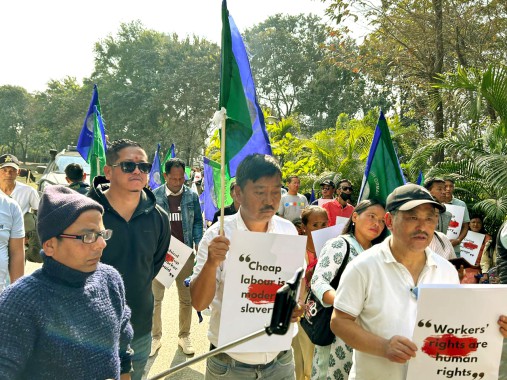
THIRST Tea News Update – February 2026
Extremes heat and cold affect tea workers’ health; land-rights and wage protests persist across S Asia. Major shifts in Kenyan tea policy.
Tea News Update 
January News Update 2026
This month’s update highlights deep structural challenges facing tea workers and producers across South Asia and East Africa, alongside emerging reforms, climate…