
THIRST Tea News Update
November 2025

Surveys indicate that most of the tea garden children in Bangladesh are deprived of primary education. Photo: Debasish Debu TBS News
The Headlines
Across Asia and Africa, tea communities continue to navigate a complex mix of challenges and opportunities, where the futures of farms, families and workers are closely intertwined. In Taiwan, younger generations are returning to family plantations, blending traditional craft with innovation to sustain livelihoods and local culture. This contrasts sharply with regions such as Bangladesh, where financial instability on plantations has left tens of thousands of children without access to education. The reopening of one school after two years, still lacking teachers, water and basic facilities, highlights how the struggles of estates ripple through entire communities.
Financial pressures also shape the choices of smallholder tea farmers, with some in Bangladesh and Kenya exploring alternative crops or diversification projects to safeguard incomes. THIRST analysis emphasises that supporting former tea workers to make these alternatives economically viable is critical as simply expanding tea exports into an already oversupplied market risks driving prices further down.
Housing, land rights and human rights remain pressing concerns across the sector. In Sri Lanka, elderly Malaiyaha Makkal families face eviction despite decades of labour, reflecting deeper structural vulnerabilities that THIRST highlighted in its Human Rights Impact Assessment report . Similarly, new land rights and education initiatives in Assam aim to provide long-term security for tea and Adivasi communities.
This month’s news update explores stories of resilience and risk, showing how governance, climate, health and innovation continue to shape tea communities worldwide.
The next generation of tea workers and farmers
In Taiwan, a new generation of tea farmers is quietly reviving the industry. In Pinglin, younger farmers have returned to their family plantations to modernise traditional practices and respond to climate change. Through the Pinglin Young Tea Farmers collective and the UChung Cooperative, founded in 2023, they are combining inherited craft with innovation to sustain livelihoods and local culture. Their cooperative approach is rebuilding pride and opportunity in rural tea communities (Taiwan News, 14/10/2025).
In Sri Lanka, the partnership between Ethical Teas and the Small Organic Farmers Association (SOFA) has created a fully organic, Fairtrade certified supply chain linking more than 2,500 smallholder tea farmers directly with buyers (Asia Business Outlook, 10/01/2025).
These cooperative efforts are in sharp contrast to the situation in Bangladesh. Across 167 plantations, only a handful of schools function, leaving around 50,000 children without primary education. A school at Bawani Tea Plantation has reopened after two years’ closure but still lacks teachers, water and toilets, exposing how financial instability in plantations disrupts entire communities (The Business Standard, 08/10/2025; The Daily Star, 14/10/2025).
Female tea workers in Kenya can now pursue long-delayed justice
A ruling by the Court of Appeal has reopened a path to justice for 51 tea plantation workers in Kenya, most of them women, after a 13-month delay in filing their appeal (Business Daily Africa, 16/10/2025; Kenya Law, 09/10/25).
The case, Keter & 50 others v Browns Investments Plc & another, alleges systemic sexual harassment, discrimination and the intentional infection of female workers with HIV by line managers. The High Court had dismissed the case in 2023, citing lack of jurisdiction over constitutional issues in employment disputes.
The new ruling allows the appeal to proceed, marking a significant moment for accountability and gender justice in the tea sector, where women remain vital yet vulnerable contributors to production.
Tea price drop crisis closes plantations
In Bangladesh, the tea sector is facing a financial crisis. Around 150,000 workers are directly employed, with half a million more dependent on plantations. At least 31 plantations struggle to pay wages, five have closed, and many operate at half capacity. High interest rates and limited access to agricultural loans, combined with government minimum prices, have failed to ensure profitability, raising concerns about further closures and a potential need to import tea (New Age Bd, 29/10/2025).
In Kenya, weaker global tea prices and foreign exchange rates have lowered factory earnings. Average prices at the Mombasa auction fell from Sh389 per kg to Sh309 while production dropped 12% to 1.2 billion kgs. Factories that maintain quality, especially in the East of the Rift Valley, continue to secure stronger international prices, helping to limit losses and sustain buyer confidence (The Star, 30/10/2025).
Wage struggles, protests highlight urgent need reform
Regional plantation companies in Sri Lanka have accepted the government’s proposal to raise daily plantation wages to Rs 1,750, although smallholder tea farmers warn the additional Rs 7.1 billion wage bill could lead to tighter productivity requirements and cuts to welfare (Sunday Times, 26/10/2025). Exporters are also under pressure from new VAT rules that may cut auction prices by Rs 20 per kilo, putting 480,000 smallholder tea farmers at risk (Daily Mirror, 01/10/2025).
Across Kenya, the government has ruled out dismantling the Kenya Tea Development Agency (KTDA), instead pursuing governance reforms to restore farmer confidence after reduced bonuses (The Star, 09/10/2025). The Tea Board’s new draft regulations and KTDA’s internal restructuring both aim to improve transparency, standardise leaf quality and secure timely payments to farmers (Citizen Digital, 14/10/2025; Capital FM, 29/10/2025).
Mounting frustration among tea workers in India continues to erupt into protest. In Assam, more than 200,000 workers and Adivasis (indigenous people) demanded wage increases, land rights and Scheduled Tribe status, halting work in over 200 plantations (The Logical Indian, 14/10/2025; Pratidin Time, 14/10/2025).
Elsewhere, 216 workers at Tanzania’s Rungwe Tea Growers’ Factory demonstrated over unpaid dues exceeding Sh2.17 billion, drawing intervention from the Tea Board of Tanzania (MSN, 01/10/2025).
Extreme weather, global warming endanger future of tea
Heavy rains and landslides in India’s Darjeeling hills have killed at least 24 people with dozens still missing. Rescue teams face blocked roads and debris as extreme rainfall, intensified by human-driven climate change, disrupts traditional monsoon patterns (ABC News, 06/10/2025).
North Bengal tea estates, including Mechpara Tea Estate, report thousands of destroyed tea bushes, washed-away processed tea and blocked roads, affecting 6,000 workers. Authorities are assessing losses and planning restoration but the scale of damage highlights the vulnerability of both workers and plantations (Devi Discourse, 06/10/2025; Millennium Post, 06/10/2025).
Globally, a study in Environmental and Sustainability Indicators (May 2025) warns that climate change will reshape tea-growing regions by 2050. Research from India, the United States and Ethiopia indicates that over half of the top 20 tea-producing countries could see declines in highly suitable land. Kenya may lose up to 26%of optimal tea-growing zones with average suitability dropping 39% (World Tea News, 20/10/2025).
Accidents, illness, insecurity highlight human cost of tea
Two separate wasp attacks at Maussakelle and Campion estates in Sri Lanka left fourteen workers hospitalised this October, highlighting the persistent exposure of workers to occupational hazards with limited protective measures (Hiru News, 01/10/2025; 24/10/2025). In India’s Darjeeling district, a tractor accident at Nuxalbari Tea Estate injured at least 25 workers en route to work, reportedly caused by unsafe transport conditions and poor road maintenance (Telegraph India, 21/10/2025).
Beyond accidents, health insecurity continues to shadow tea communities. Flood survivors in Jalpaiguri’s Bamandanga-Tondu plantation remain displaced, living in unsafe makeshift shelters vulnerable to wildlife intrusion (Telegraph India, 23/10/2025). In Kenya, reforms to the National Health Insurance Scheme have left smallholder tea farmers struggling to access medicines, forcing many to pay privately for basic care (The Independent, 02/10/2025).
Amid these challenges, a positive step emerged in India, where UK-based charity Lepra, alongside Haddenham Healthcare and Tea People, launched two specialist health centres in Assam to improve treatment, rehabilitation and health education for tea communities (Eastern Eye, 03/10/2025).
Tea communities fight for security and recognition
Tea communities across Asia continue to struggle for the right to live and work with dignity. In Sri Lanka, nine Malaiyaha Makkal (Indian origin Tamil) families in Galle District face eviction after 80 years on the Hammeliyawatte plantation. Despite generations of labour, they were denied formal employment records, social security or fair pay, receiving only ration vouchers. Local NGO Voice of Plantation People condemned the move as inhumane, calling for urgent government action (AsiaNews, 20/10/2025).
Meanwhile, India’s Assam state has announced a bill to grant land rights to tea garden workers after widespread protests by tea and Adivasi (indigenous) communities. The government also pledged new schools and reserved education and job quotas to support tea families’ long-term welfare (Hindustan Times, 16/10/2025).
Innovation and diversification provide hope for tea sector
Kenya is broadening its agricultural exports as demand for herbs and spices grows across Europe under the Kenya-EU Economic Partnership Agreement (People Daily, 25/10/2025). The Kiru Tea Factory in Murang’a county has launched an avocado diversification project with support from the Kenya Tea Development Agency Foundation, TechnoServe, CASA and SokoFresh to help farmers expand income amid volatile tea prices (The Star, 11/10/25).
The tea industry in Bangladesh faces a crisis. In Panchagarh, low prices and poor plantation management have forced many to replace tea with vegetable farming. Experts call for government support to make alternative crops viable rather than expanding oversupplied tea exports (The Business Standard, 02/10/25).
Vietnam has developed integrated tea zones in Hanoi, with cooperative management, traceability systems and closed-loop production chains. These measures improve quality, reduce costs and provide stable markets with farmers earning 250-300 million dong per hectare annually (Vietnam Pictorial, 19/10/2025).
This News Update was written by Sarah Amankwah
To get THIRST Tea News Updates direct to your inbox, subscribe to our newsletter below
Share this update
Sign up for our monthly newsletter to stay in the know about human rights in the tea sector
Each issue of our newsletter includes:

A summary of the latest tea sector news

Upcoming THIRST events

THIRST news and updates

New reports and resources from our Knowledge Hub
Latest news, views and events
View all Upcoming Event
 Tea News Update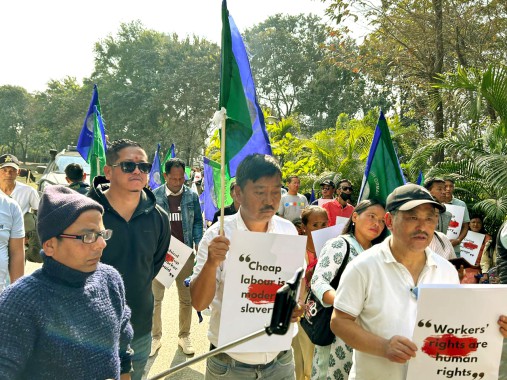
THIRST Tea News Update – February 2026
Extremes heat and cold affect tea workers’ health; land-rights and wage protests persist across S Asia. Major shifts in Kenyan tea policy.
Tea News Update 
January News Update 2026
This month’s update highlights deep structural challenges facing tea workers and producers across South Asia and East Africa, alongside emerging reforms, climate…