
THIRST Tea News Update
November 2024
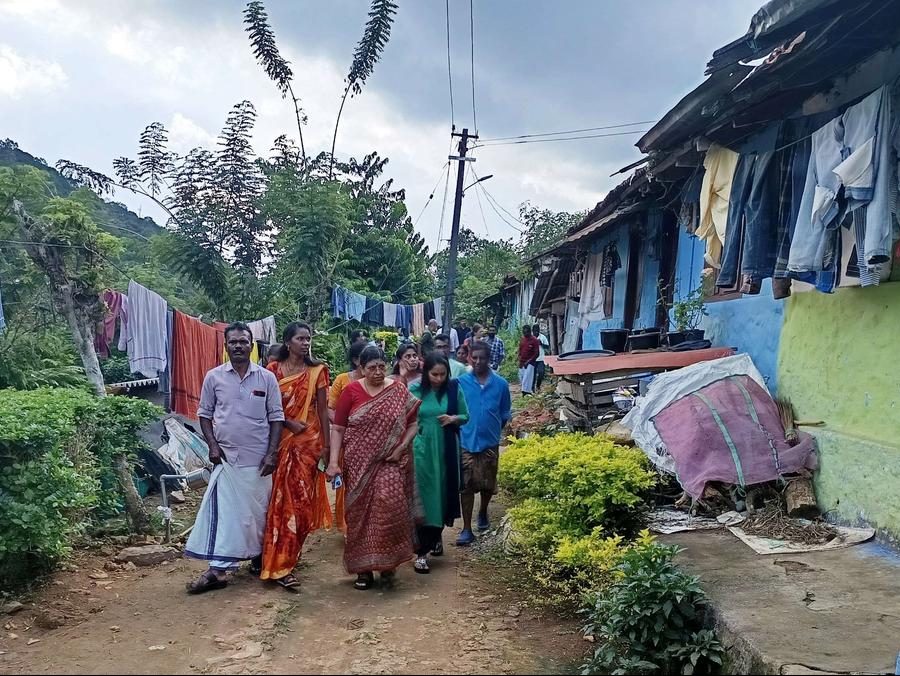
Women tea workers showing the dilapidated condition of their homes to members of the Kerala Women’s Commission. The Hindu
Highlights: Bangladesh tea workers face starvation; low pay for workers across tea value chain – high profits for some; violence in the tea world
Bangladesh – A Microcosm of the International Tea Crisis:
“If the garden authorities don’t pay our wages and rations soon, we will starve.” Bangladesh tea worker
Last month we told you about the existential crisis in the Darjeeling tea sector. If even such an iconic and up-market tea as Darjeeling, the “Champagne of Teas”, is struggling it is no surprise to learn that things are even more desperate in Bangladesh. This has been starkly evident in the news items over the past month.
“The tea industry in Bangladesh is a fast-growing sector contributing millions of dollars to the economy.” (Dhaka Tribune, October 16th). In 2023, it exported over 1 million kg of tea, the majority to Pakistan and the U.A.E, but 81,500 kg of which went to the USA and European countries[1]. The departure of Bangladesh’s Prime Minister, Sheikh Hassina on August 5th, has left the highly politicised tea sector in turmoil – particularly the partly state-owned National Tea Company Limited (NTC). The more than 12,000 tea workers in its twelve plantations have not been paid since August when they received only half their wages.
One worker reports that “Each day is a challenge, as we survive on just water, salt, and rice. The shopkeepers have stopped offering credit, and I feel too ashamed to ask anyone for help.” (Daily Star, October 31) Another describes her situation and raises a stark warning: “I don’t have a husband, and I used to barely manage the household with the little money I earned,” she says. “But now, even that has stopped. For the last six weeks, I haven’t received any salary or rations, and I have no money left… If the garden authorities don’t pay our wages and rations soon, we will starve.” (BDNews24.com, October 27)
In response, workers are going on strike (Daily Star, October 26th) and preventing consignments of tea leaving the factory. (Daily Star, October 11th). While these actions may seem counter-productive when the company is already struggling, this is perhaps the only leverage they have. The day that they released a consignment, they were paid a week’s wages.
While the problems at NCT have been ascribed to mismanagement (Daily Star, October 11th), the company is also plagued by the same challenges that tea companies the world over are currently facing; over-supply leading to low prices (despite which the government has a policy to expand the tea-growing areas) and the impacts of climate change. Other Bangladesh tea companies that are struggling include Imam, which shut down in October last year and Fultala, whose 1,600 workers have not been paid for twelve weeks. According to a government source:
“79 tea gardens are in terrible shape. These gardens have not made their due contributions to the Provident Fund (PF) for months. Gas and power lines have been cut off in a number of the gardens for not paying the bills. Many of them are selling green tea leaves to other tea gardens for processing as their own factories are not running.”
Philip Gain, researcher and director at the Society for Environment and Human Development (SEHD), suggests that the interim Bangladesh government should “overhaul the tea industry to ensure justice for the tea workers.” His call to action echoes that of other commentators urging the government to ensure that this time tea workers are included in reforms, (The Business Standard, October 4th)
Specifically, Gain recommends that they:
- Map the tea industry identifying good and bad practice and all are kept under proper scrutiny and made accountable.
- Fix a just and respectable wage structure for workers.
- Address discrimination in the labour laws and regulations for tea workers: according to Solidarity Country Program Director AKM Nasim; “Though tea workers are covered under the Bangladesh Labor Act, they do not enjoy the same protections as workers in other industries.” (The Business Standard, October 31st
- Enforce existing laws which, he claims, are subject to “owners’ routine violation”
As with Darjeeling, what is happening in Bangladesh is a microcosm of the tea sector as a whole. Urgent and concerted efforts need to be made by governments, the industry and civil society to come to the rescue of the tens of thousands of workers and their dependents who are being crushed under the wheels of the behemoth in crisis.
NB: Look out for a new book, ‘Tea Workers of Bangladesh – Realities and Challenges’ – authored by Philip Gain and Fahmida Afroze Nadia of Nazdeek to be published by SEHD later this year.
Low pay for women throughout supply chain – high profits for some
While disputes over wages and bonus payments continue across India, the issue of intense workloads and low pay for tea workers – particularly women – creates stress and industrial unrest across the whole of the supply chain. As we reported in the last News Update, workers at a Tetley tea packaging factory in the UK were described as a “loyal, predominately female workforce [which] has endured year after year of real terms pay cuts” (BBC, September 20th) – a situation with strong echoes at the production level.
The GMB union had accused the company of trying to intimidate its factory workers instead of addressing their concerns over pay after it took legal action against them for alleged trespass and engaging in “intimidating” behaviour towards managers. (Business Matters, October 2nd). But the dispute has now been resolved to the satisfaction of trade unions and the company with a 10% pay increase over two years (BBC, November 1st).
But the thousands of women plantation workers who have been protesting against low bonuses (The Statesman, October 18th) and low pay or non-payment of wages and benefits (Telegraph India, October 10th) have not (yet) been so fortunate. And it is not only in their wage packets that the poverty of women tea workers is evident: this month, women tea workers showed the dilapidated condition of their homes to members of the Kerala Women’s Commission. KWC Chair said women should not remain silent when they faced exploitation at workplaces. (The Hindu, October 23rd)
Some argue that the pressures of workers in the mainstream tea industry are a result of shrinking demand for tea and insufficient money in the tea value chain to cover decent pay and conditions for all its workers. Yet there are clearly profits to be made; we learned this month that Tata Consumer Products, one of the world’s biggest and most powerful companies selling tea and other consumer products, has been “expanding its distribution network, including in small towns and villages, to capitalize on… growing demand [in rural areas of India],” (Reuters, October 18th) and that it is one of a handful of Indian companies to “Hit the Rs 1 Lakh Crore Milestone” – ie whose shares are now worth more than £9 billion. (ETNOW, October 31st)
Such profits tend to be concentrated at the retail end of the value chain. Yet even here, workers are put under extreme pressure; workers in China’s beverage retail industry are “Facing relentless demands and tight deadlines.. leading to burnout, clashes with customers”. (Sixth Tone, October 10th).
These stories raise the question of whether the extreme concentration of profits at the packaging and retail end of the tea market is sustainable in the long-run. Industrial disputes, labour shortages, media exposés of human rights abuses in the tea sector – not to mention the collapse of more and more plantations, pushing thousands of workers and their families into destitution (The Statesman, November 7th) – could all be addressed through a more equitable share of value.
Violence in the tea world
Last month saw numerous troubling stories of violence against people working in the Indian tea sector; their attackers ranged from wild animals to police and (suspected) militants.
Suspected militants of the banned United Liberation Front of Asom-Independent (Ulfa-I) kidnapped a tea factory supervisor from the Himalaya Tea Company in Tinsukia district near the Assam-Arunachal Pradesh border. (Times of India, October 15th). Two employees of Dehing Tea Estate were assaulted by unidentified assailants (one dressed in police uniform) who then, bizarrely, handed each of them Rs. 500 for medical treatment and fled the scene. (India Today NE, October 5th)
But the authorities, too, resorted to violence this month; police resorted to a lathi [large stick] charge on tea workers at Fatemabad Tea Estate in Baksa district, who were protesting to demand the bonus that was due to them, resulting in one worker being seriously injured. (India Today NE, October 9th)
Tragic stories of human-animal conflict on tea plantations crop up all too commonly in our News Updates, and this month is no exception: a four-year-old girl, the daughter of a migrant tea worker from Jharkand was mauled to death by a leopard. (Times of India, October 4th)
Fixing underlying issues
How could this litany of poverty, industrial unrest, gender inequity and violence be addressed? This month saw media reports of numerous attempts to address the tea sector’s problems including government intervention, adopting new women-friendly business models, reducing tea volumes and increasing quality, as well as technical and environmental fixes.
Government intervention and support
The Indian Government’s interventions include the Ministry of Commerce and Industry’s approval of a Rs 664 crore budget for the tea industry including plantation development and quality upgrading, tea promotion and market support, technological intervention, R&D, welfare and capacity building measures. (Assam Tribune, October 5th). Where government intervention has not been effective, the courts have stepped in; India’s Supreme Court has summoned Assam chief secretary over delay in clearing tea workers’ dues. (The Telegraph, October 23rd). In more positive news, people living in tea plantation have been exempted from the Assam government’s ban on constructing new houses, and are allowed to build their own homes within tea estates. (India Today NE, October 20th)
Meanwhile, Darjeeling small tea growers have written to the Tea Board of India, seeking a complete ban on import of Nepal tea into India, especially during winter when tea production in India stops. (The Telegraph, October 27th)
New business models
John Snell says that in today’s tea sector “There is more room for newcomers than ever before.” (John Snell, October 24th) One such new entry is the all-woman run specialty tea company in Assam, Donyi Polo. It addresses environmental as well as social issues by combining tea cultivation with social forestry and farming, shunning the CTC manufacturing model. And its teas have set auction records (East Mojo, October 13th).
Tripartite Stakeholder Collaboration
Tripartite stakeholders celebrated the successful conclusion of ILO’s ACCEL Africa project in Malawi that aimed to accelerate the elimination of child labour in tea and coffee supply chains of six African countries. The project’s approach involved policy reforms, community empowerment, and collaboration amongst key stakeholders. (ILO October 22nd)
Data-driven multi-stakeholder dialogue
Another ILO project aims to strengthen the Assam Minimim Wage Board by facilitating data-driven dialogues between the Government, trade unions and employers. The project asserts that minimum wage setting in Assam “is now based on scientific data, incorporating needs of workers and their families, plus other economic factors.” (ILO, 30th October )
Reducing Quantity
The rising pile of unsold tea in the Mombasa auction has forced the Kenyan Government to drop the minimum reserve prices set in 2022, which aimed to cushion farmers from falling prices. (The Guadian, October 12th). But small-scale tea farmers in Kenya are reportedly still facing losses. One day last month, 89.7% of the tea on offer was rejected by buyers. (All Africa, October 23rd). Distributing tea seedlings to farmers may be beneficial to those individuals in the short run, but arguably, in the long run it will only add to the global oversupply currently holding tea prices back. (Nyasa Times, October 5th)
The price effect on reduced quantities was demonstrated this month in South India, where tea farmers were reported to be in “jubilant mood” as green leaf tea prices registered a sudden jump to around Rs 22 per kg. (Onmanorama, October 27th) Although this is the result of impacts such as climate change, it is a clear demonstration that an intentional reduction in the production of tea – both in India and globally – would benefit prices. A multistakeholder approach could ensure that only the highest quality and more efficiently produced tea remained, with those tea workers and farmers earning a living income. Governments should ensure that those who are currently engaged in uneconomic tea production are provided with alternative income generation prospects.
Increasing Quality
But of course better prices don’t come with reduced quantity alone. One commentator suggests that the market for tea in India could thrive by going up the value chain, producing smaller batches with greater care and variation in processing and educating consumers on why it’s worth paying more for the greater labour involved in making them. (The Scroll, October 16th) Another asserts that “Only after loving tea trees can workers learn how to harvest properly.” (Vietnam, November 1st)
Tech fixes
KTDA has installed anti-tampering gadgets on green leaf weighing scales across its 71 managed factories. They are designed to eliminate any discrepancies in the weighing of Green leaf delivered by over 700,000 smallholder tea farmers at buying centres. (Kilimo News, October 15th)
Environmental fixes
In the Tea-CUP project (Co-developing Useful Predictions) scientists from the UK’s Met Office and China have been working with tea experts and local farmers in Yunnan Province to understand what seasonal and climate information they need to inform adaptation measures. The projects inclusive approach ensures that services are tailored to the specific needs of users, considering factors beyond scientific evidence, such as cultural values and social norms. This new joint approach helps tea farmers adapt to climate challenges by providing timely and relevant climate information.. (Met Office, October 23rd)
News Fannings
- Update on Chebochok sexual abuse allegations: John Chebochok, who was secretly filmed in a BBC Panorama/BBC Africa documentary in 2023 pressuring a woman to exchange sex for work, faced a hearing under Constitutional Petition No. E006 of 2024. Wangu Kanja Foundation, part of Kenya’s Coalition Against Sexual Violence, are supporting the survivors of his alleged abuse to come forward and testify safely and anonymously. According to WKF, following the respondents’ testimonies, all parties will be required to submit written arguments within 21 days, after which the Court will set a date to review compliance. (Wangu Kanja Foundation)
- Ugandan tea farmers seek government aid Tea farmers, under the Ugandan Tea Outgrowers Association have called on the Government to extent the National Agricultural Advisory Services programme for an additional 3 years. (New Vision, October 15th) Onesimus Matsiko, Chairman of the Ugandan Tea Outgrowers Association said “Right now, there’s no good combination of a fair price with timely payment. Farmers often face a trade-off: accept a lower price for immediate payment or wait for an extended period to recieve a better price.” (New Vision, October 14th)
- Trade union troubles: Fissures have appeared in the joint movement by hill trade unions for a 20 per cent bonus with the tea union of the Hamro Party deciding to walk out of the joint forum. (Telegraph India, November 7th), and in Assam, tea workers have demanded financial accountability from Assam Chah Mazdoor Sangha trade union over the use of funds deducted from their wages. (India Today NE, October 27th)
- New film explores the lives of Indian Tamils in Sri Lanka‘s tea plantations and their role as domestic workers in middle-class households… The project stems from Ram’s personal connection to the community. “Witnessing Tamil maids employed across middle and upper class households evokes deep discomfort, prompting an honest exploration of pain and frustration,” (Variety, October 5th)
______________________________________________________
[1] Calculated from figures provided in Statistical Bulletin of Bangladesh Tea Board for the Month of March, 2024
Share this update
Sign up for our monthly newsletter to stay in the know about human rights in the tea sector
Each issue of our newsletter includes:

A summary of the latest tea sector news

Upcoming THIRST events

THIRST news and updates

New reports and resources from our Knowledge Hub
Latest news, views and events
View all Upcoming Event
 THIRST news
THIRST News August 2026
THIRST seeks new Chair; Darjeeling Tea Multi Stakeholder Roundtable 27 Nov; Behind the Brew Update; Next Circle of Tea meeting 29 Sept
 Tea News Update
August Tea News Update 2026
Tea industry pivots from volumes to value amid price, cost and climate shocks; efforts to tackle, mitigate climate impacts; Indian tea company…