
THIRST Tea News Update
August / September 2024
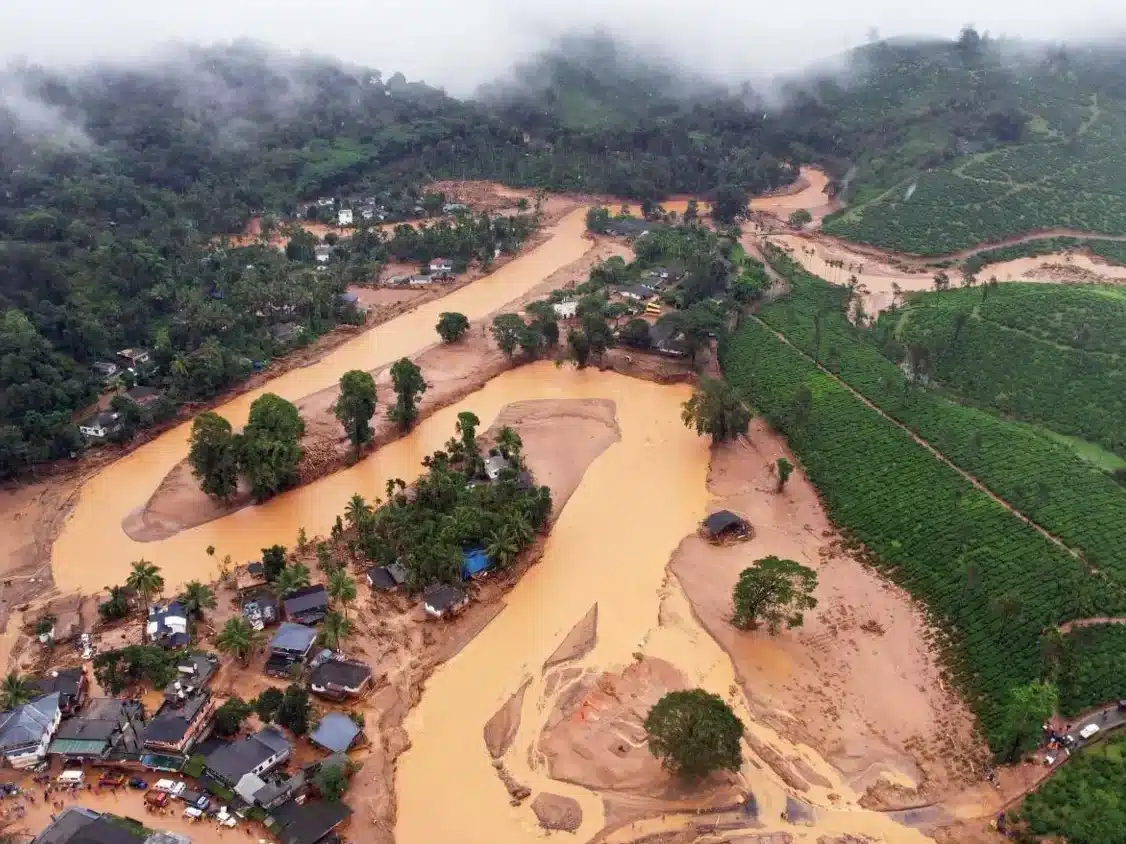
Image: Arun Chandra Bose – BBC. Massive landslides hit Mundakkai and Chooralmala in Wayanad district
Highlights: Landslide kills 250, incl. tea workers. Collaborative campaign keeps sex abuse suspect from power. Can buyers help break tea deadlock? Litigation & violence over land. Minimum tea prices – curse or boon?
THIRST News
THIRST’s HRIA Findings – Tools to help us plan for the future of the industry
We are now nearing the completion of the third phase of our human rights impact assessment of the global tea sector. Our three reports in the HRIA series (the Literature Review, the Root Cause Analysis and Alternative Approaches) will soon be joined by a fourth documenting the findings from a series of tea community workshops in Kenya. These sought the thoughts, ideas and aspirations of tea workers and farmers themselves, including the younger generation who are the future of the industry. A final report will bring together all the lessons from the HRIA and provide the industry with evidence-based tools, resources, insights and case studies to help improve the realisation of human rights for tea workers and farmers.
We are now in discussion with tea companies, NGOs and other stakeholders to develop the next phase of our work – putting the HRIA findings to the test on the ground.
Watch this space for our next virtual multistakeholder roundtable to discuss the overall findings and how they can help us all plan for the future.
THIRST welcomes Leena Camadoo to our Board of Trustees
THIRST is delighted to welcome Leena Camadoo to our Board of Trustees. With over 17 years of experience in value chain and market systems development, Leena is passionate about reducing economic inequality with a particular focus on gender transformative approaches. Leena spent 10 years working in the Fairtrade sector and has previously held roles with CARE International, Oxfam and the Ethical Tea Partnership as a gender advisor. She now works as an independent consultant.
Leena says “I am honoured to have been appointed as a Trustee of THIRST and I am looking forward to contributing to THIRST’s future development. At this challenging time when the tea sector is contending with the intersecting impacts of climate change, precarious incomes and gender injustice, THIRST’s work in ensuring that tea workers’ and farmers’ representatives have a place at the discussion table is more critical than ever.”
August and September Headlines
Contents
Deadly landslide shows need for urgent housing review
Chebochok case: The power of collaborative action to challenge GBVH
Could buyers help break the wages deadlock?
Litigation and violence over tea land ownership and use
Minimum price – a curse or a boon?
In other news…
– Estate closures and struggles:
– Non-payment of wages:
– KTDA challenged to close loss-making subsidiaries
– A positive conversion: tea workers’ children take up rugby
Deadly landslide shows need for an urgent housing review
On July 30 the largest landslide in India’s history killed at least 250 people, injured hundreds more and wiped out two entire villages. Commentators say that the landslides “show that climate change is here to stay and [that] the need for adaptation is clear and present.” (The Hindu, Aug 17)
But they also show that there is an urgent need to review the housing policies on tea plantations. As with earlier landslides in tea-growing areas, hundreds of those affected were tea plantation workers. One survivor of the July Wayanad landslides said estate workers living in the area expected there to be landslides in August and usually moved to safer places (delaying this move by a few days proved fatal). (New Indian Express, Aug 1). This clearly demonstrates that workers’ housing remains in areas known to be prone to landslides where the British located them decades ago. Indeed, “a 2011 report submitted by a panel of experts, led by ecologist Madhav Gadgil, had classified the entire Wayanad region as “fragile, medium fragile and less fragile area”.” (BBC, 31 July)
The relevant authorities and the tea industry should conduct a detailed review and a risk analysis of all tea workers’ plantation housing location to avoid such devastating an unnecessary loss of life and limb in future.
When 61 people, mostly tea workers and their families, were buried alive in the 2020 landslide in Pettimudi, Munnar, a local police chief stated “If they were provided with their own land and safe houses away from the highly vulnerable, ecologically fragile zone of the tea estate, the landslide may not have killed anyone. They all lived in a narrow-spaced cluster of workers’ quarters which was located in an area highly vulnerable to landslides.” (Huff Post, Aug 18, 2020).
Chebochok case: The power of collaborative action to challenge GBVH
The election of John Chebochok as director KTDA’s Toror tea factory in Kenya has been nullified by the Ministry of Agriculture and Livestock Development. This action follows a long campaign by various social organizations in Kenya and beyond – including THIRST – after accusations of sexual exploitation were made against him in a BBC Panorama programme, where he was also filmed by an undercover journalist demanding sexual favours in exchange for work. (Nation, Kenya edition, August 5). A coalition of Kenyan Women’s rights organisations led by the Wangu Kanja Foundation continue to pursue the matter in the courts, seeking to ensure that Chebochok is declared unfit to hold public office. (X, July 8).
It was the coordinated, sustained public outcry against Chebochok’s election by tea industry actors, government, civil society and the media that has ensured that a suspected sexual abuser has not retained a position of power. But it is important to remember that the underlying issue, beyond Chebochok’s individual case, is how to ensure that there are sufficient and effective checks and balances in place – in both the tea industry and in every tea producing country – to eliminate the risk of GBVH that women in the tea industry continually face. ‘Consent’ – the briefing paper by THIRST, Women Working Worldwide and T-Evolve provides valuable information and advice on this. We will continue to work with the industry towards the elimination of GBVH with impunity in the sector.
We will also watch with interest other initiatives that seek to address GBVH issues in the sector, including Malawi’s new gender policy to combat sexual harassment in the tea sector which involves trained “Gender champions” are one of the initiatives, together with proactive policies and advocacy. The policy has been formed in collaboration with the International Labour Organisation, Solidaridad and the Tea Association of Malawi Ltd. (Kilimo News, September 2)
Could buyers help break the wages deadlock?
As reported in previous THIRST News Updates, there has been a back and forth process on the decision by the Sri Lankan government to increase the minimum wages for tea workers to Rs 1700 (Rs 1350 as daily minimum basic salary and an additional Rs 350 as a special allowance) – a 70% increase. Tea plantations have been adamant that they cannot pay the increased amount, seeking court intervention which overturned the original gazette. (Daily News, August 13) However, the Wages Board has once again voted that plantations should pay the increased amount (Hiru News, Sept 10), although the position of plantations is unlikely to have changed. Meanwhile, the lives of some Sri Lankan tea workers are reportedly still on the edge with problems ranging from low wages to the dilapidated conditions of their colonial line houses (Daily Mirror, Aug 8).
One way that plantations have been trying to reduce costs and increase wages is through the “revenue share model” (covered in THIRST’s report on Alternative Approaches in the tea sector). However, if not managed correctly it can lead to more problems than solutions. Workers at the Madulkele estate say that the current form of the revenue share model is not working because it is unregulated, leading to workers feeling that they are being exploited and overworked, with no substantial increase in income. (Sunday Times, Aug 4)
It is clear that unless plantations are able to access or release additional funds – for example through buyers of Sri Lankan tea factoring the increased wage into their pricing – the deadlock is unlikely to be broken.
It is not only at production level that wages fail to enable tea workers to enjoy a decent standard of living. A worker at a UK factory making Tetley tea bags and packaging tea has revealed that she has had to rely on benefits to top up her wage and is using a food bank to feed her children because she “can’t provide adequately” for them on her current wage. She and her fellow workers at the factory have confirmed they will go on strike, rejecting a 4.4% pay rise and demanding a pay rise to match that of last year which was almost twice as much. (BBC, Sept 3)
These stories underline the now widely accepted point that there is simply not enough money in the tea value chain to provide those that work within it with decent livelihoods. The latest report on tea estates by India’s Comptroller and Auditor General has echoes what many civil society actors have been saying for years, that workers are suffering; the report said that the implementation of social welfare schemes for tea workers in Assam has been “dismal” and that poor social and economic conditions and lack of education and development facilities continue to hamper their social upliftment. (North East Live, Aug 31)
The Assam government’s announcement of a 3% quota of government jobs being reserved for people from tea plantations and the Adivasi or indigenous community will provide alternatives for some. (Times of India, Aug 23). But more needs to be done urgently to address the root causes of the poverty and breaches of the human rights of the vast majority of tea workers.
Bonus news: In Darjeeling, tea workers’ unions come together on a common platform to demand a higher bonus for the year. This is an annual problem and some feel that a united force will put more pressure on companies and government (The Telegraph, Sept 6). While in Assam the government has okayed a 20% bonus (the maximum permissible under law) for workers of the Assam Tea Corporation Limited, before the festive season begins in India. (G Plus News, Sept 5)
Litigation and violence over tea land ownership and use
Over the past few News Updates, THIRST has been following the dispute between Kenya’s Kipsigis and Talai communities and Liptons regarding their sale of their estates to Sri Lankan company, Browns instead of to the indigenous communities. They have now legally challenged the Lipton-Browns deal, which they say will not only deny them their rights to land and livelihood, but is also an abdication of responsibility by erstwhile colonial powers. (STIR, July 30)
Land rights issues also affect plantation workers in India, when the land that they have lived on for generations, but do not own, is threatened with take-over or a change of use. Another ongoing land dispute story is that of Manjolai tea estate in Tamil Nadu, India. Many of the Bombay Burmah Trading Corporation workers’ whose jobs were terminated in June are now living on the streets. A case has now been filed with National Human Rights Commission, to give the workers forest rights so that when the estate land is reclaimed by the forest department at the end of the company’s lease in 2028, those who have called the area home for five generations can remain. (The New Indian Express August 9 and The New Indian Express July 26)
Land use disputes also arose in Assam, where Ledo Tea estate workers have been protesting against a bypass road which has destroyed several acres of mature tea plants. Workers say that the road is badly constructed, leading to water-logging which has affected the estates. (India Today North East, Aug 9). The same workers also have to contend with a hospital which is desperately short of medical staff. (India Today North East (video) July 26).
Such disputes can result in violence; the Assam Tea Tribes Students Association have held massive protests over the brutal treatment of Hatikuli tea estate workers by the local police during agitations to stop the land being given away to developers to build a five-star hotel. (The Sentinel, Aug 3)
Minimum price – a curse or a boon?
Echoing other tea producing countries, there has been a year-long trend in falling tea prices in Uganda with middlemen offering as little as 130 shillings per kg of tea. Once the tea harvester has been paid 100 shillings, the 30 shillings left are insufficient for tea growers to maintain their plantations. Several have either burnt their plantations or shifted to crops like maize to survive. Both the government and tea associations are trying to tackle the problem. (New Vision August 12)
One response to falling prices is to set a minimum price for tea. It is now well-known that this strategy dramatically backfired in Kenya, where tea stocks from previous years continue to lie unsold. The backlog has left tea farmers grappling with the stagnant stock they say is caused by the minimum price set by the government, and trying to earn a profit. Earlier in the year, buyers had rejected the tea on offer because they claimed the price was too high. Over half the stock at auction was therefore withdrawn. Experts suggest the minimum price should be linked to the intrinsic value of the tea rather than production costs. (Business Day Africa, August 14)
Whether because lessons from Kenya have not been learned, or because the context is so different, stakeholders in Assam’s tea industry, including small tea growers, have agreed that fixing a minimum floor price for tea is the only way forward for sustaining the industry in the country. This system, they feel, will be a win-win situation for all stakeholders, from producers to buyers to the government. Currently, small tea growers receive about Rs 20 per kg on average. With the new system, they would get at least Rs 35 per kg. The suggestions at the meeting will now be placed before the government. (The Sentinel, Aug 15)
In other news…
Estate closures and struggles:
Over 800 tea workers of the Chandan Tea Estate in North Bengal abruptly lost their jobs when the management shut down the tea estate with no explanation. The state labour department has tried to intervene, but the management has not shown up for meetings (Millennium Post, Aug 6). These estate closures are taking place virtually every month signalling serious instability in the tea sector.
Non-payment of wages:
Thousands of Assam tea workers who were part of Andrew Yule and Company have not been paid wages for over two months. The company which was taken over by the government is now in the process of disinvestment. The tea division has seen persistent losses, exacerbated by climate change impacts such as heaving flooding. However with the rest of the company remaining profitable, the disinvestment process is being looked at with some suspicion (Northeast Now, Sept 6).
KTDA challenged to close loss-making subsidiaries:
The Deputy President of Kenya has warned the Kenya Tea Development Agency that the government will close down its loss-making subsidiaries; urging the organisation to stick to focusing on selling tea and ensuring that its 800,000 tea farmer members maximise their income (Standard Media, Sept 6).
A positive conversion:
For the children of tea workers in one village in Bengal, rugby has given them wings! (Nikkei Asia, Aug 6)
Share this update
Sign up for our monthly newsletter to stay in the know about human rights in the tea sector
Each issue of our newsletter includes:

A summary of the latest tea sector news

Upcoming THIRST events

THIRST news and updates

New reports and resources from our Knowledge Hub
Latest news, views and events
View all Upcoming Event
 THIRST news
THIRST News September 2026
• • This month’s upcoming THIRST events, new Knowledge Hub resources, Chair recruitment and more. See also September’s Tea News Update. Photo:…
 Tea News Update
September Tea News Update 2026
Tackling climate impacts is “operational necessity” for tea; “seismic structural shift” in Kenyan tea sector; wage unrest spreads across India, Bangladesh.